Worth as a Collector
‘… a vast bibliographic arsenal which needs consideration and study’.
Dr Giovanni Gorini.[1]
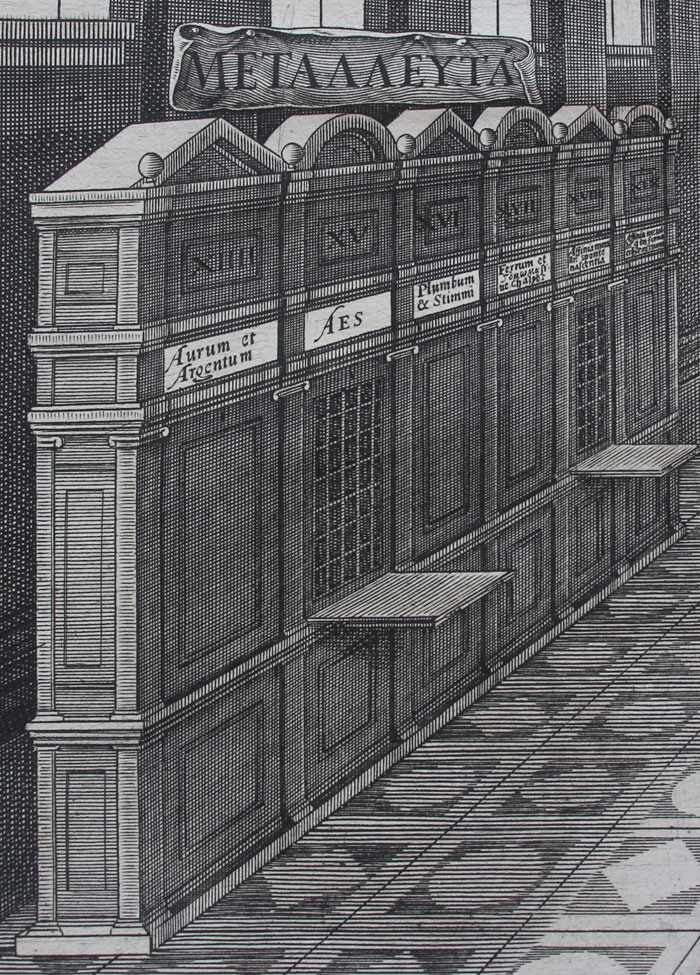
Michele Mercati, Michaelis Mercati Samminiatensis Metallotheca : Opus posthumum, auctoritate, & munificentia Clementis unidecimi Pontificis Maximi e tenebris in lucem eductum opera autem, & studio Joannis Mariae Lancisii … illustratum. Cui accessit appendix cum XIX. recens inventis iconibus … (Rome, 1719), double plate before p. xlix, detail depicting seventeenth-century collecting cabinets for precious stones and metals – part of numismatic collecting.
Introduction
The ‘lost’ libraries of the world continue to fascinate and intrigue. What were the collections that made up the great library of Alexandria before its demise? What was held in Baghdad’s House of Wisdom prior to its sacking in 1258? Ongoing projects attempt to re-establish both grand libraries and smaller ones, albeit imperfectly. However, when it comes to the collection of the Dublin physician, Dr Edward Worth (1676–1733), we have no such sleuthing to conduct. Although much, even most, about Dr Worth is hidden in the dust of time, his diligent and perceptive searching, acquiring and gathering, was not squandered by an improvident family, nor has his bequest been countermanded by an ungrateful or would-be beneficiary. None of the vagaries of national politics, the progress of medical science, changes in institutional character or shifts in the building’s purpose have obliterated the originator’s labour of love. As it was gifted in 1733, so, in the main, it continues to the present day. In the same room the collection resides, in the same bookcases the books rest, secured by the same doors, visible through the same glass – ‘a fossil library, that is frozen in time’.[2]
Frozen in time, but not in place, and so we may question Muriel McCarthy’s attribution of ‘fossil’. Each tome’s binding and content remains accessible. Book by book, each volume can be browsed – they still live and breathe and speak with all the verve of yesteryear! As each volume once served Dr Worth, so each continues to serve us. As he exploited them for the needs of his times, we too can exploit them for the needs of ours. Scholars increasingly have been spending time on and within their covers. Numismatically speaking, therein we find gold and all manner of precious things. Hence my undertaking to excavate and exhibit, for Ireland’s numismatic community, and others beyond it, Dr Worth’s accumulated treasures. It is not just the bibliographer who benefits from this bookish delight. The researchers of the field have here a rich source. The collector of coins, medals and seals, too has the depths of a deep sea to plumb. The historian of the discipline can trace how it has evolved across time. That a man of culture, in an impoverished Dublin at the turn of the seventeenth and eighteenth centuries, managed to pull together such a collection is quite remarkable. That it remains as he intended is little short of a miracle!
Dr Edward Worth (1676–1733)
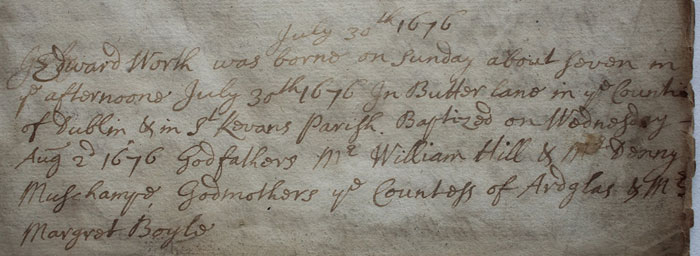
The Holy Bible containing the Old Testament and the New: Newly translated out of the originall Tongues, and with the former translations diligently compared and revised by his Majesties speciall command … (Cambridge, 1629), flyleaf, detail: Excerpt about Edward Worth’s birth in the Worth Family Bible.
‘Edward Worth was born on Sunday about seven in the afternoon, July 30th, 1676, in Butter Lane, in the County of Dublin, and in St Kevan’s Parish’, so reads his father’s entry on the front endpapers of the Worth Family Bible. No similar entry records his death, which occurred only a short distance away in Werburgh Street, fifty-seven years later, in 1733.[3] His remains lie in his uncle’s tomb, on the south side of the choir, beneath the cathedral floor, in St Patrick’s Cathedral, Dublin. He spent most of his life in Dublin, apart from a few youthful years abroad for study in Merton College, Oxford, and later at the University of Leiden. The surviving evidence suggests that his travel was solely for formal education and did not include a ‘Grand Tour’, though Dean Swift (1667–1745), was less generous in his estimation:
‘What niggard father would begrudge his brass,
When travell’d son doth homebred boy surpass;
Went out a fopling, and return’d an ass?’[4]
Benson tells us that ‘Much medical education was undertaken in Great Britain or the Netherlands, France and Italy, for the medical school in Trinity College was only put on a proper footing in 1711’.[5] Kirkpatrick notes that ‘After leaving Oxford he studied medicine abroad and entered the University of Leiden on November 18, 1699’, and ‘graduated Doctor in Medicine at Utrecht’, 1701.[6] As to whether he journeyed to other European cities, we have not yet been able to ascertain.
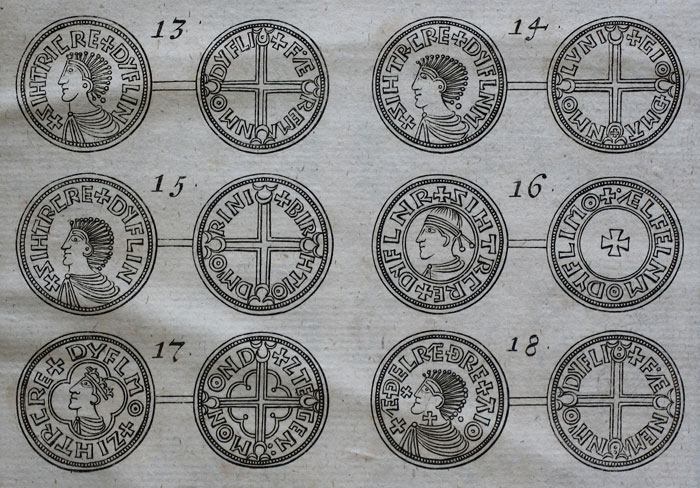
Nils Keder, Nummorum. in. Hibernia. antequam. haec. insula. sub. Henrico. II. Angliae. Rege. Anglici. facta. sit. juris. cusorum. indagatio. per. Nicolaum. Keder. … Accessit catalogus nummorum Anglo-Saxonicor. & Anglo-Danicor. musei Kederiani (Leipzig, 1708), plate II, nos. 13–18: images of Sitriuc Silkbeard (Sitric, Sigtryggr Ólafsson Silkiskeggi) (d. 1042), king of Dublin.
Worth lived during a period of scientific revolution. He had been forced to leave Ireland to pursue medical studies due to inadequate local provision, but on his return he found Dublin transformed. He began to practice medicine at a time when Dublin had risen to be the second city in the British Empire, despite its precarious economic state. The Anglo-Irish connection was a factor in this growth. Dublin’s population was second only to London, and in a European setting, larger than that of Berlin and Rotterdam.[7] In the first decades of the eighteenth century it would be augmented ‘with one of the world’s great libraries, in the Long Room of Trinity College’, the largest single chamber library in Europe at that time, built despite not having the books to fill it.[8]
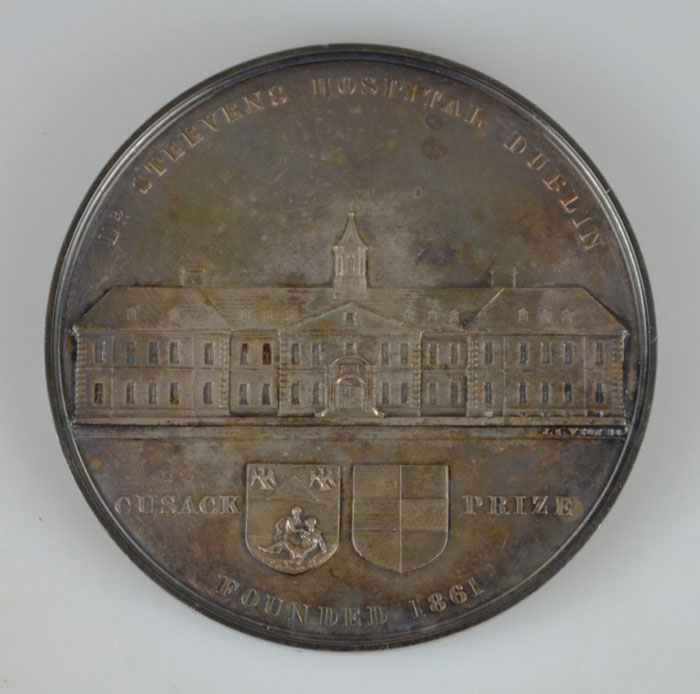
James William Cusack Prize Medal (depicting Dr Steevens’ Hospital)
TPCK/9/22a
Reproduced courtesy of the Royal College of Physicians of Ireland.
The architect of the Old Library in Trinity College Dublin, Thomas Burgh (1670–1730), was likewise the architect of the institution to which Worth bequeathed his library. As Davis Coakley notes, the ‘hospital was formally declared opened on Monday, 23 July 1733’, four months after Worth’s death.[9] Coakley suggests that, ‘[a] room, which also served as the board room, was especially designed by Edward Lovett Pearse to receive the books’ but Christine Casey challenges this idea, arguing that: ‘Though the design of the room has been attributed to Sir Edward Lovett Pearce, a trustee from 1730 until his death in 1733, there is little to suggest his involvement other than the detailing of the order, which a good carver might surely have managed unaided. Though deeply atmospheric, this is not an interior of the first rank’.[10] The room was ‘completed in 1742’, nine years after Worth’s death.[11] Dr Worth died on 28 February 1733 and was buried in St Patrick’s Cathedral on 2 March 1733.[12] A first formal statement of the bequest was made to the hospital governors on 12 March, and the money from Worth’s estate arrived with the institution on 22 July.[13] A press report on Saturday 12 May recorded that several cart loads of Worth’s boxed books had arrived the previous week at Dr Steevens’ Hospital.[14] Worth’s Will was being expedited!
All this is not surprising for Worth’s social standing went far beyond his medical qualifications and expertise. Kirkpatrick tells us that the Worth family ‘had played a considerable part in the history of Ireland during the seventeenth century’.[15] His father’s eldest brother William (1646–1721), with whom Edward was close, had been Second (i.e. inferior) Baron of the Court of Exchequer under Charles II (1630–85), and James II (1633–1701). Afterwards, as a manager of the estates of James Butler (1665–1745), Duke of Ormonde, William had added considerably to his already substantial wealth. Edward’s own father, John Worth (1648–88), had been Dean of St Patrick’s Cathedral, Dublin. Within this milieu of wealth and status, Dr Worth established himself and his medical practice with aplomb, numbering among his patients, Archbishop Thomas Lindsay (1656–1724), and Sir Richard Levinge (1656–1724).[16]
Dr Worth, A Collector for Others?
However, over and above these few facts, little more is known about him. Yet, as Westerhof notes, though ‘We may know little about the man himself, … through his books and environment … we may be able to gain an insight into his mind’.[17] The contents of Worth’s bequest, coupled with the Will itself, certainly gives us pointers to his intentions. His contemporaries, Claudius Gilbert (1670–1742) and Narcissus Marsh (1638–1713), both made clear that their libraries were intended for a ‘community of readers’, but no similar sentiment motivated Worth.[18] Only a very small coterie of specialists (the physician, chaplain, and surgeon of Dr Steevens’ Hospital) were allowed to have access.[19] However, Worth does seem to have been aware of its great potential despite the small number of readers permitted access to it.
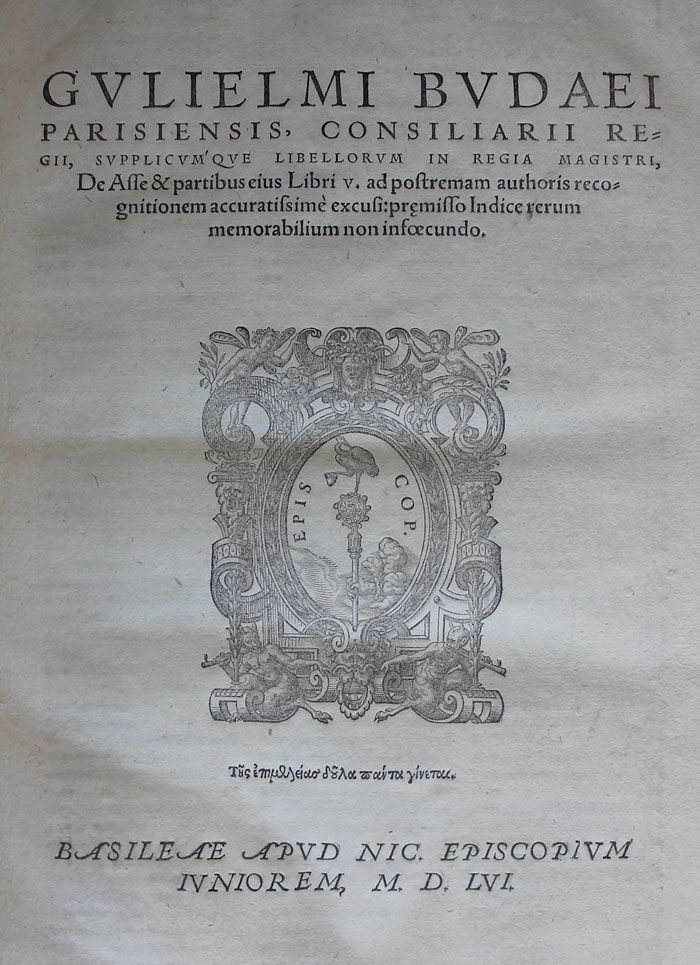
Guillaume Budé, Guilielmi Budaei Parisiensis, consiliarij Regij, supplicum’que libellorum in Regia magistri, De asse & partibus eius libri V. ad postremam authoris recognitionem accuratissimè excusi: pr[a]emisso indice rerum memorabilium non infœcundo (Basle, 1556), title page. This is widely viewed as the first book on numismatics.
The library he was leaving to Dr Steevens’ Hospital was his own collection, according to his own preferences, with books bound to his own specifications. Although his books were stored in several locations, those ‘English books in the glass-case’ in his study and an assortment of his father’s books at Rathfarnham were evidently less important to him.[20] Some of those at Rathfarnham eventually came to the library after the death of Dr Worth’s cousin, Edward Worth (d. 1741), who had been given the option of buying his uncle’s books.[21] Therefore, some level of discrimination and segregation had already taken place in Worth’s siting of his books. At some point, and certainly by 11 November 1723, ‘considering the uncertainty of human life’, Worth had decided to allocate his fund of money and his fund of books to others.[22] As a result, despite all the privilege and vagaries of the times, Worth emerges as both altruistic and beneficent. Among the over four thousand volumes he bequeathed to the hospital was a substantial collection of books on numismatics.
Dr Worth, a Coin Collector?
Did Worth collect coins himself? Certainly the collecting of coins and medals was common in Ireland during his lifetime.[23] At least one surviving sales catalogue belonging to him included coins and medals offered for sale in Ireland: in an auction catalogue dating to 1729, A catalogue of books to be sold by the administrators of the reverend John Nicolson, late Rector of Donogh-more in the County of Donegal. (Being the library of the late Arch-Bishop of Cashel (Dublin, 1729), we find an advertisement for the disposal of a medal collection belonging to someone Worth was likely to have known well, William Nicolson (1655–1727), Bishop of Derry (and Cashel), who sat in the Lords of the Irish Parliament during Worth’s tenure as an MP. The catalogue advertises ‘a Collection of curious Medals in Gold and Silver, and other Medals, to be dispos’d of’.[24] William Nicolson authored the Irish Historical Library (1724), a copy of which Worth possessed. This work contains a chapter on ‘Irish Coins and Medals’, the most substantial treatment of the subject in English at that time.[25]
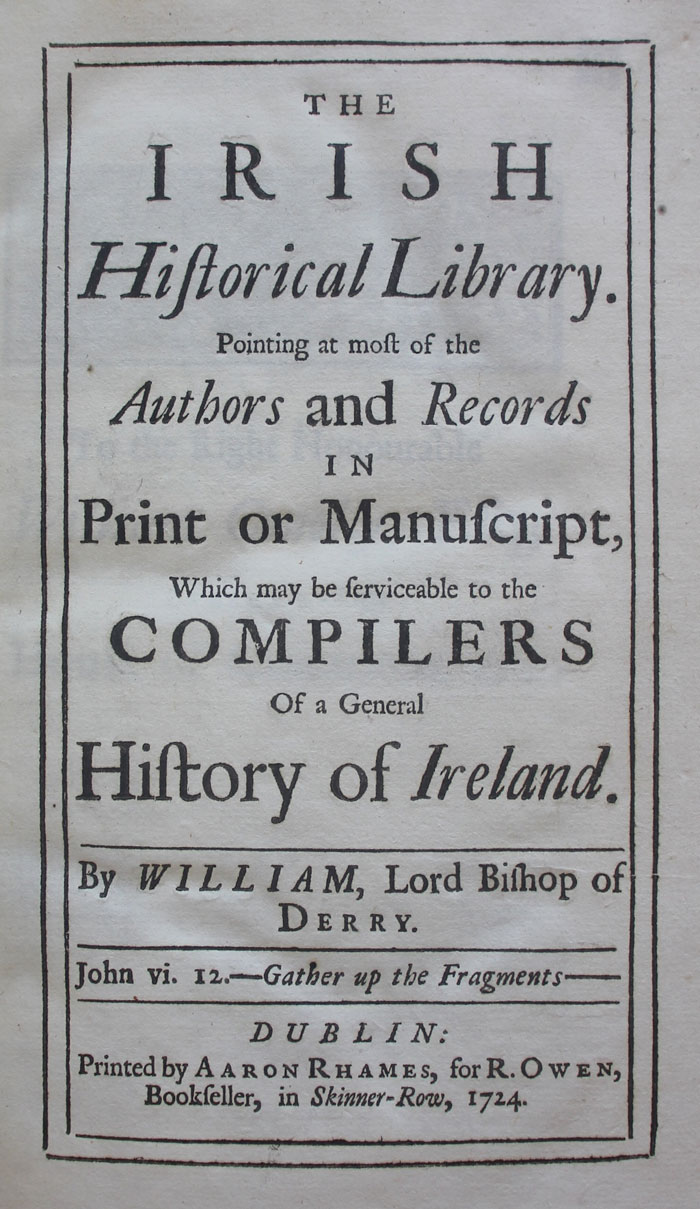
William Nicolson, The Irish historical library. Pointing at most of the authors and records in print or manuscript, which may be serviceable to the compilers of a general history of Ireland. By William, Lord Bishop of Derry. … (Dublin, 1724), title page. The earliest English-language treatment of Irish coinage.
Worth did not limit his interests to the coinage of Britain and Ireland, as his extensive collections of key texts concerning sixteenth-, seventeenth– and early eighteenth-century numismatic collectors demonstrates. His continuing interest in the collecting of numismatic specimens is seen in his copy of Liebe’s work on the collection of the dukes of Saxony-Gotha-Altenburg, which appeared in 1730: Gotha numaria, sistens thesauri Fridericiani numismata antiqua aurea, argentea, aerea, ea ratione descripta, ut generali eorum notitiae exempla singularia subiungantur, auctore Christiano Sigismundo Liebe. Accedunt ex Andreae Morellii Specimine uniuersae rei numariae antiquae excerpta, & Epistolae tres Ez. Spanhemii, quibus rariores eiusdem thesauri numi illustrantur (Amsterdam, 1730).
However, when it comes to collecting, we have no suggestion that Dr Worth gathered a coin cabinet of his own, that is a collection of medals, seals, or coins. His Will gives no indication beyond a reference to ‘ten pieces of gold’ and his interests appear to have centred almost entirely on books.[26] Had he amassed coins and medals in any significant quantity, it is most likely that they would have fallen under the same proposed fate as the books ‘which did belong to [his] late father, … at Rathfarnham’ – sold off to enable their monetary value to be realised and bequeathed to a worthy cause.[27] But no such instruction or codicil exists.
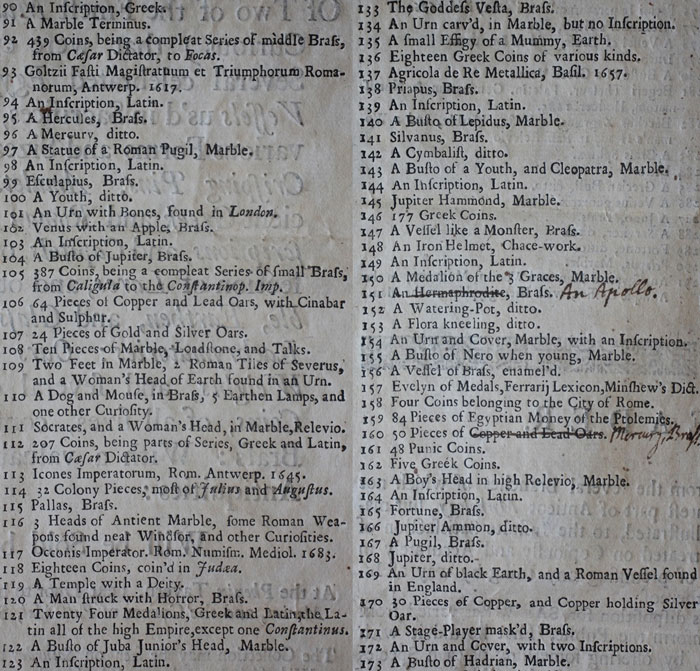
A catalogue of the antiquities of the late ingenious Mr. John Kemp, F.R.S. … will be sold by auction … on Thursday the 23d of March … (London, 1721), pp 2–3, details.
An inspection of his books and auction catalogues gives us a fair idea of his interests. As a medical man, he may well have been interested in the first listed items on the title page of A catalogue of the antiquities of the late ingenious Mr. John Kemp, F.R.S., consisting Of Two of the Finest Mummies (esteem’d so by the Curious) that were ever brought from Egypt … (London, 1721).[28] But perhaps his interest in the catalogue was also to keep up to date with the market on ‘Seals: … Ancient Weights, and several compleat Series of Original Coins, of all sizes, consisting of Gold, Silver and Brass’.[29] We are unlikely ever to know whether he collected coins or medals, as the catalogues remained largely unmarked. The evidence really points to the fact that his focus and primary interest was on books, books, and more books.
Dr Worth: a Collector of Numismatic Literature
As for being a collector of numismatic literature, there is no doubt about the matter. The numismatic literature within the Worth Library has fallen below the radar of most who have written about the library. For example, in 1924 Kirkpatrick, in enumerating the topics treated in the library, listed ‘medicine, surgery, chemistry, botany, and pure and applied mathematics … history, topography, antiquities, and books of reference … ancient classics … theology and some modern literature’.[30] In 1986 Muriel McCarthy listed ‘philosophy, politics, history and belles lettres … architecture, antiquities, astronomy, mathematics, history, science and travel’, but made no mention of numismatics.[31] Coakley, in his A Brief History, published in 1992, also omits the numismatic content of the library, focusing instead on ‘surgery, chemistry, botany, history, topography, the classics and theology’.[32] In 2004 Kelly listed ‘medicine, science, history, theology, topography, antiquity and other subjects’ while six years later Lyons gave as a flavour of the library, ‘alchemical, astronomical, mathematical, medical, and philosophical works’ but numismatics fails to make the list.[33] However, the current Librarian, Elizabethanne Boran, in highlighting some of the topics of Worth’s collection in 2015, does include numismatics – perhaps the first time that numismatics was recognised as an important component within the library.[34] Four years later, during a Society of Bookbinders visit to the library on 29 April 2022, at which I was present, Dr Boran mentioned in passing the numismatic content. As I had some knowledge at that time of a project being undertaken by the Royal Mint Museum on the Numismatic Library of Sarah Sophia Banks (1744–1818), the seed was planted that would grow into an exploration of the numismatic literature within Dr Worth’s Library. I argue that it forms an important part of his book collecting and that its importance has been considerably underrated until now (see my statistical analysis towards the end of this webpage). The evidence of his numismatic collection and auction and sales catalogues suggests careful deliberation in choosing numismatic titles for his own library.
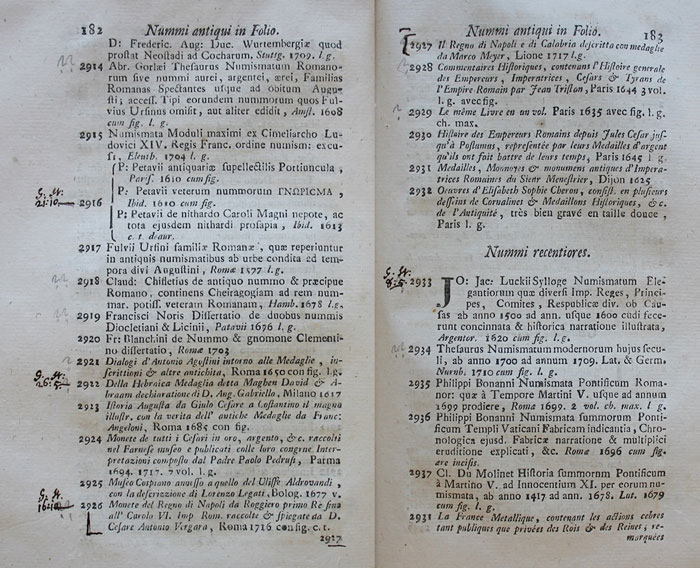
Johannes Swart and Pieter De Hondt, Bibliotheca Hulsiana, sive catalogus librorum … collegit Samuel Hulsius … Quorum auctio habebitur Hagae-Comitum … die 4. Septemb. & sequentibus 1730, 3 vols (The Hague, 1730), i, pp 182–3: numismatic purchases by Worth.
Dr Worth’s purchasing power as a book collector was greatly enhanced when, on the death of his uncle William, he received a sizeable bequest.[35] We have evidence of substantial book purchases following this generous inheritance, with a single 1724 international auction netting forty-eight books, though it must be acknowledged only three in that sale were of obvious numismatic interest according to their titles.[36] Sir William’s fondness and generosity toward his nephew may have developed when, as a twelve-year-old, Edward lost his father, being already bereft of his mother at the age of five years. Perhaps it developed later in life because of their close proximity, as it was only a short ten-minute walk from Werburgh Street to Aungier Street, where William had a town house. It is easy to see how the uncle’s experience as Second Baron of the Exchequer would have aligned with the nephew’s interest in national economics.[37]
The question arises whether Worth read the numismatic literature in his library. In addressing the caution expressed by some commentators, we need to be wary of making assumptions based on the relatively pristine state of his collection.[38] Close and frequent reading does not always leave visible marks of wear. The absence of an owner’s signature, annotations or marginalia often accompanies the extreme care a collector takes with a book as material object. The few books we know Dr Worth perused and annotated are in no worse condition than those showing no signs of use.
Dr Worth, A Numismatic Collector by Choice or Circumstance?
Was Worth a numismatic dilettante, indulging an affordable curiosity, or was his collecting shaped by civic necessity? The evidence suggests that circumstances played a central role in forming his body of numismatically relevant literature for the year 1715 witnessed Dr Worth’s foray into politics. With his reputation as a medical doctor now well established, not to mention his important family connections in the Dublin of his day, Dr Worth was elected to the Irish House of Commons for the seat of New Ross (a port town on the River Barrow, Co. Wexford, 150 kilometres south of Dublin). Worth was the second of two MPs elected for the town. We may be surprised to learn that in the early half of the 1700s those with the vote in that town borough were only a handful, being the sovereign, burgesses, and freemen (perhaps no more than 20 persons); though it could boast that it was one of only two boroughs with Roman Catholic freemen, at that time.[39]
Worth’s election to office is dated 24 October 1715 by the New Ross Town Council.[40] He was admitted Member of Parliament on 12 November 1715 and his term ran for twelve years until parliament was prorogued following the death of George I (1660–1727), King of Great Britain, on 11 June 1727.[41] As for parliamentary records, the Journals of the Irish Parliament of that time are rather sketchy. Debates are not recorded, so none of Worth’s speeches are thought to exist but resolutions and orders are, and any relevant committee members are named.
The nature of Worth’s contributions as an MP is instructive and seems to shed a great deal of light on the subject matter of his book collecting. He appears to have purchased extensively to support his work as an MP. As ‘a very high Tory’ what was his interest in republican and Commonwealth-era material?[42] Or Williamite revolution-era material? Was it to better understand the political and economic context of his own day’s economic woes? Although dating from the era of his grandfather, we know that Worth did not inherit many of the interregnum pamphlets from either grandfather or father but purchased them.[43] In addition to these works in the Worth Library, it is said that the Newenham Collection of pamphlets in the Gilbert Library was ‘Begun by Dr Worth in the seventeenth century … specialising in political and economic topics … an invaluable resource for the study of this period’.[44] Was Dr Worth’s interest in this material because of his new engagement as a MP for New Ross? Was Worth, ‘nourished by reading among others, a Bodin, a Dumoulin, a Selden, and a Grotius … founding, on arguments drawn from the history of economics …’ and ‘citing his authors, opening to his fellow citizens the possibility to know, in a domain where their everyday life was directly involved, the new principles, the new ideas, the possibility to try new ways’?[45]
As a physician, one might expect his parliamentary activity to relate primarily to health and certainly he was involved in one parliamentary commission which concerned public health. On Tuesday 12 September 1721, he was appointed to a committee tasked with drafting an address to the king regarding measures to protect the kingdom from a ‘contagious distemper, which now rages in a neighbouring country, and applying such remedies, as may tend to revive our trade, and restore the Nation to a flourishing condition, and to return our humble thanks for his readiness in directing a commission to pass under the great seal for receiving voluntary subscriptions in order to establish a bank in such manner, as may be most beneficial to the Kingdom …’.[46] This entry suggests that members of that Parliament were actively seeking solutions to their economic difficulties, and this might provide reasons for many of Worth’s purchases of numismatic literature, particularly the sammelbands relating to Irish finances and national economic decisions stretching farther back than the Commonwealth of Cromwell’s day.[47]
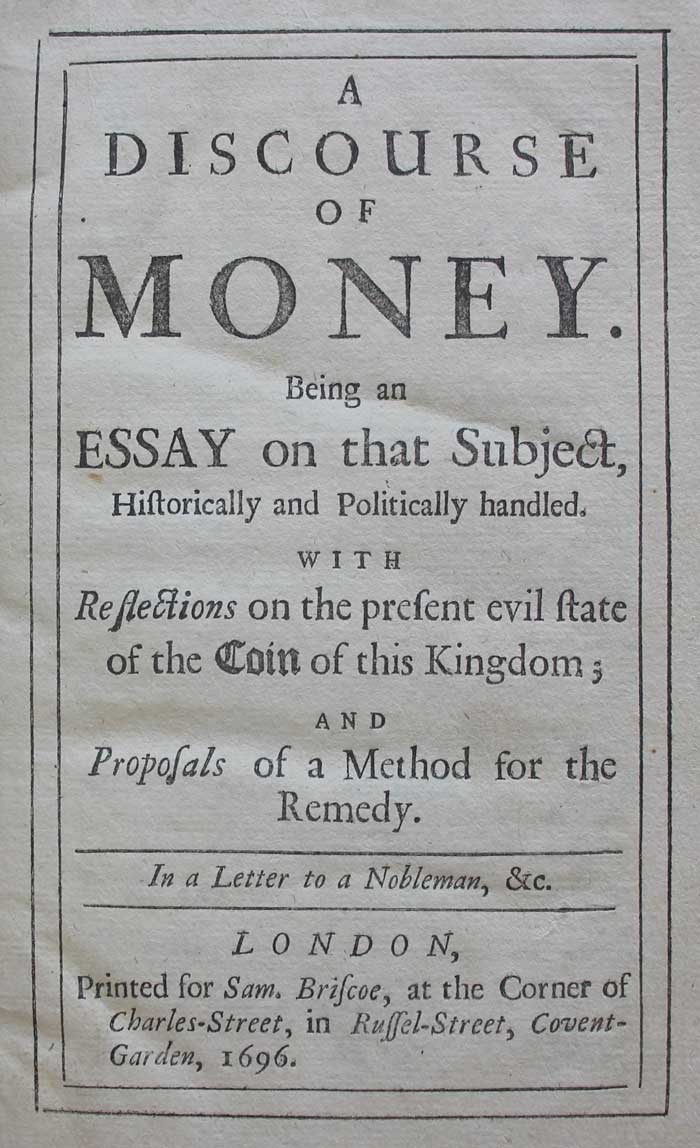
[John Briscoe], A discourse of money. Being an essay on that subject, historically and politically handled. With reflections on the present evil state of the coin of this kingdom; and proposals of a method for the remedy. In a letter to a nobleman, &c. (London, 1696), title page. One of many pamphlets during the lifetime of Dr Worth dealing with the state of Irish coinage.
Worth’s proficiency in finance and economics, reflected in the numismatic material in his library, appears to have fitted him for several of his parliamentary roles. On Friday, 6 September 1717, his name ‘was added to a Committee appointed to inspect the publick accompts of the nation’.[48] His involvement in numismatic affairs of state was intense. On Thursday, 21 September 1721 it was, ‘Ordered, that leave be given to bring in heads of a bill for the better securing the payment of bankers notes or bills, and that Doctor Worth, Mr Brownlow, Mr Attorney General, and Mr Agmondisham Vesey, do prepare and bring in the same’.[49] It is noteworthy that Dr Worth is mentioned first, perhaps indicating his importance in this matter. On a separate matter, he appears on another committee list the following day: ‘Ordered, that the persons under-named or any seven or more of them, be appointed a Committee to meet, in the Speaker’s chamber, tomorrow morning at ten of the clock, to inspect the several publick accompts and papers laid before the House …’.[50] Worth returned to Parliament for the third consecutive day, this time rising to speak on the floor of the House: ‘Doctor Worth, according to order, presented to the House heads of a bill for the better securing the payment of bankers notes or bills, which were received and read, and committed to Committee of the whole House tomorrow morning. Ordered’.[51] The record for the following morning shows that at ten o’clock Dr Worth was again absent from his medical practice as he attended to civic duties: ‘[t]hen the House, according to order, resolved itself into a Committee of the whole House to take into consideration heads of a bill for the better securing the payment of bankers notes or bills, and, after some time spent therein, Mr. Speaker resumed the chair. Doctor Worth reported from the Committee, that they had made some progress in the matter to them referred, and that he was directed to move the House for leave to sit again’.[52] The following morning sees him back again in the same capacity as his Saturday appearance and addressing the same request to the House, and he makes a further appearance on Monday, 2 October, mirroring his previous requests.[53] The sparse official record provides little indication of the extensive hours of labour undertaken in committee on these matters of state and the impact it would have on his medical practice and health.
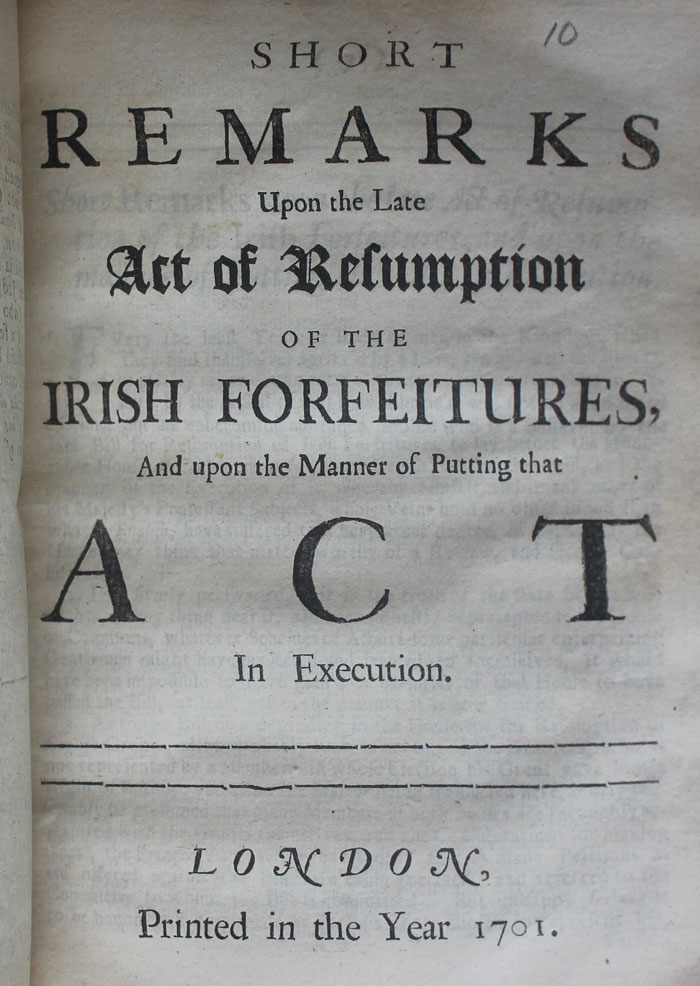
Sir St. John Brodrick, Short remarks upon the late Act of Resumption of the Irish forfeitures, and Upon the Manner of Putting that Act in Execution (London, 1701), title page.
A couple of years later, Worth received a particularly notable engagement. On Saturday, 7 September 1723, he was appointed to ‘a Committee to meet, on Monday morning next at ten o’clock, in the Speaker’s chamber, to inspect the state of the hempen and flaxen manufactures, and to consider, what is necessary to be done for the farther improvement and regulation thereof: … and that all Members who come to the said Committee are to have voices’.[54] One week later, 14 September, he was appointed to a group, ‘to inspect the several public accounts and papers laid before the House’.[55] Meanwhile, the matter of William Wood’s coinage had become a national news story and had been before the house from at least the previous day.[56] Over the next two weeks Parliament discussed the issue and formed a committee (which did not include Worth) to draw up an address from the Parliament to the King. It may be to this period that we can date the beginnings of Worth’s ‘long illness’.[57] Certainly, within a few short weeks he was ‘considering the uncertainty of human life, [and was] desiresous (sic) to settle [his] worldly affairs’.[58]
Dr Worth, a Numismatist?
One can be a coin or book collector without being a numismatist. A collector may simply enjoy acquiring interesting pieces. A numismatist, by contrast, attains some degree of proficiency in their chosen area quite apart from casual collecting. Worth’s reputation as a numismatist appears to have been well established. On 25 September 1730, at the inaugural meeting of the new Board of Governors of Dr Steevens’ Hospital, he was chosen, despite ill‑health, to serve on a sub‑committee of three tasked with designing the hospital’s seal. This suggests he was recognised as having an interest in numismatic items, whether coins, medals or seals. That the group was ‘to meet at Dr Worth’s chambers ‘to consider of a seal for the Corporation’’ may indicate that he led the work and that his numismatic literature was to be consulted for ideas or inspiration.[59] The biblical figure of the Good Samaritan, portrayed by Luke the beloved physician in his Gospel, was an apt emblem for the new institution. Chart notes, ‘The seal of the hospital is a design of the Good Samaritan healing the wounds of the fallen traveller with the motto beneath ‘Do Thou Likewise’’.[60] Rembrandt’s 1633 etching of the Samaritan delivering the wounded man to an inn may have influenced Worth and his colleagues in their choice of subject matter.
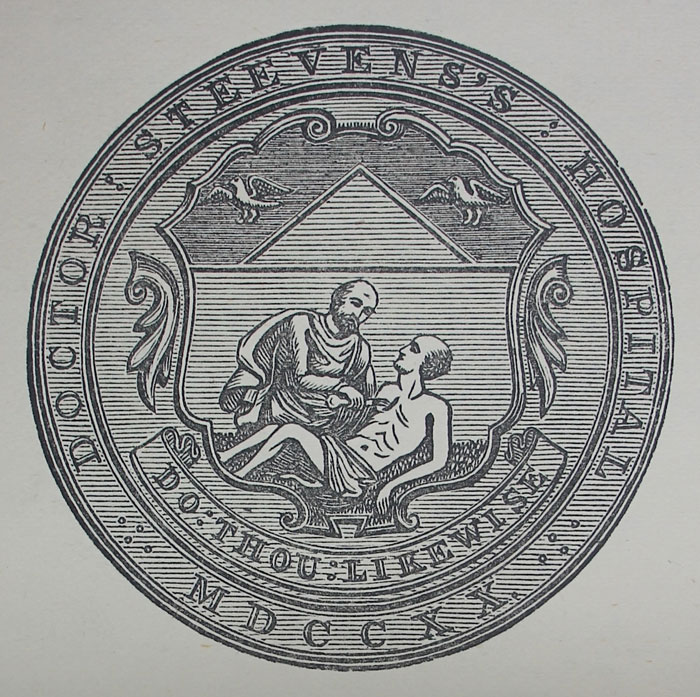
Governors and Guardians of Dr Steevens’ Hospital, Doctor Steevens’ Hospital : Report of the Governors and Statement of Accounts for the 1885–6 (Dublin, 1866), title page, detail: Seal of Dr Steevens’ Hospital depicting the good Samaritan.
The committee chose to depict the fallen traveller as thin and gaunt, a portrayal more akin to the Dublin ‘poor sick people’ than to the figure presented by the Evangelist.[61] They sought to impress upon their contemporaries a sense of personal responsibility by quoting part of Christ’s command, ‘Go and do thou likewise’. Two doves, symbols of peace, harmlessness and purity of motive, hover over the depiction. Another point of interest is the orthographic rendering of the possessive ‘Steevens’s’, whereas today it is usually written Steevens’. This seal is the only coin‑like item associated with Dr Steevens’ Hospital during Worth’s lifetime, that we are aware of, and he was intimately involved in its design and production.
Whether Worth collected coins or medals is of secondary importance in determining his status as a numismatist, for his perceptive acquisition of a substantial body of numismatic literature is itself his credential. Nor was he an accidental numismatist, for he actively scoured the ‘Numismatici’ sections of his sales catalogues, annotating them with purchase prices either upon hearing of his successful acquisitions or upon the books’ arrival.[62] The catalogue of the library of Samuel Huls (1655–1734) shows that of at least thirty‑four titles purchased, six were clearly numismatic.[63] The evidence suggests that Worth’s interest in numismatics continued throughout his long illness and into the closing years of his life.
Dr Worth’s Numismatic Collection – An Analysis
It may seem strange to start an analysis of a library by considering what is not in it, but when one gets to know Dr Worth, there are works one would expect to find in his collection that are not present. For example, although seven works of Newton survive, his The Present State of Ireland: Being Sir Isaac Newton’s Representation about the Gold and Silver Coins … (Dublin, 1729) does not. Other works that must have interested Worth are similarly missing, though their absence today does not necessarily mean they were never part of his library. Kirkpatrick suggested that ‘English literature is poorly represented in the library, probably because the majority of Worth’s English books were contained ‘in the glass case’ which he bequeathed to ‘Clotilda Lady Eustace’.[64] It might be tempting to conclude that some of these were numismatic texts but research by Dr Ralph Stevens in 2017 strongly suggests that this cohort comprised primarily theological texts. John Worth’s collection, bought by Edward Worth of Rathfarnham, presents another temptation, for the collection was divided between the Worth Library, Trinity College Dublin, while some were retained by the descendants of Edward Worth of Rathfarnham, the Newenhams, and subsequently became part of the special collections of Dublin City Library in Pearse Street. However, these are readily identifiable within the Newenham archives since John Worth always signed his name on his texts.[65]
One of the more surprising gaps in the Worth Library is the absence of many printed works of the 1720s on the Irish economy and on Woods’ copper coinage. Given Swift’s supposed satirical attacks on Worth, the absence of Swift’s contributions is perhaps less surprising, but the absence of William King’s works and the many anonymous publications is more puzzling.[66] Although King and Swift were ‘Church Tories and State Whigs’, Worth, a ‘very high Tory’, is unlikely to have ignored Whiggish contributions to the economic writing of his era. Absence should not be taken as proof that he did not own such material. The most important contributions of Jonathan Swift and William King (1650–1729), Church of Ireland archbishop of Dublin, to Irish literature were shaped by economic concerns, as the Drapier’s Letters demonstrate.[67] Even Gulliver’s Travels, with its ‘king of Brobdingnag’, is seen by some to introduce elements of Enlightenment philosophical thought into economic reflection, despite resistance to the practical consequences of Enlightenment ‘improvement’.[68] It is difficult to imagine that Worth did not engage with this literature. Did Worth give numismatic material to his cousin, Edward Worth of Rathfarnham, as he too was a politician? Were Worth’s pamphlets un-shelved and perhaps boxed up in the Werburgh Street house-clearance with other ephemera only to find their way to the home of Worth’s executor? Further work on the Newenham Pamphlets in the J. T. Gilbert Collection, which contains much material on the Irish economy, may possibly indicate a Worth provenance, though determining which pamphlet previously belonged to Dr Worth and which belonged to his cousin may well prove impossible. If so, it would demonstrate that not all of Worth’s literature of numismatic significance remained with the collection in Dr Steevens’ Hospital.
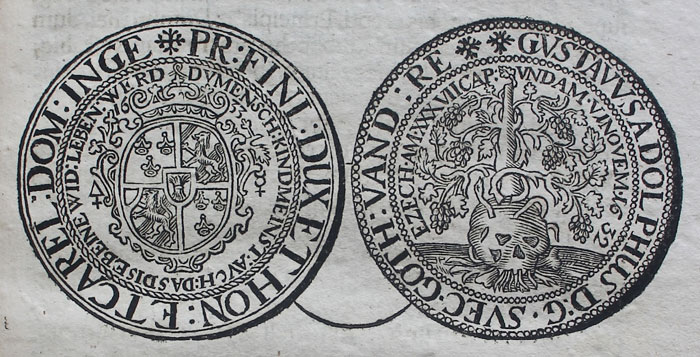
Samuel Reyher, Dissertatio de nummis quibusdam ex chymico metallo factis (Kiel, 1692), p. 9, detail. Coin collecting was encouraged even in children. This coin, among others, was given to Reyher by his godfather at his baptism as an infant, 1635.
We are on firmer ground when we examine the wonderful collection of numismatic works Worth left to Dr Steevens’ Hospital. My investigation, though extensive rather than exhaustive, identified 402 works of numismatic relevance out of an overall collection of c. 4,400 volumes, including 14 auction and sale catalogues that specifically categorised numismatic literature and coins.[69] Discounting these catalogues leaves 388 other relevant titles. The languages represented break down as follows: Latin, 59%; English, 29.4%; French, 8.3%; Italian, 2.8% and Spanish, 0.5%. This shows that Worth was at ease working across a breadth of European learning and could fit comfortably into the Republic of Letters. Dutch is conspicuous by its absence – though Worth would not have needed it for his academic pursuits at Leiden since Latin was the lingua franca of education.
The literature spans the sixteenth (7%), seventeenth (60%) and early eighteenth (33%) centuries. The earliest work dates to 1516 and deals with weights and measures, while the latest dates to 1730 and is the library catalogue Worth provided for in his Will. Of the total works identified, 21.9% remain uncategorised. Of those analysed, 54.5% are core numismatic literature, with 23.6% being works on other subjects that contain numismatic content, sometimes in significant quantities. This latter category is material that would qualify for inclusion in standard numismatic bibliographies such as Lipsius, Leitzmann or Dekesel. Dekesel’s Bibliotheca Nummaria is a monumental twenty‑first‑century bibliography, groundbreaking in its detail and extent. Of the Worth numismatic corpus, 60.3% is listed in Dekesel. Much of the remaining 39.7% consists of Parliamentary acts and statutes, which Dekesel intentionally disregards nor does he list anonymously printed material. To explore numismatic topics further, see Dekesel Categorizations.
Dr Worth’s numismatic literature provided not only breadth but also a depth of national and international thinking of the most up‑to‑date kind, which he could apply to the business of parliament. Before the term ‘macroeconomics’ was coined, Sir William Petty (1623–87), a favourite author of Worth, had already applied broad national analysis to economic issues and had situated Ireland within a wider European context (see, for example, his Political Arithmetick (London, 1691)). He focused more specifically on Ireland in his Further observation upon the Dublin-bills: or, Accompts of the houses, hearths, baptisms, and burials in that city (London, 1686); The Political Anatomy of Ireland (London, 1691), and A treatise of taxes and contributions … applied to the present state and affairs of Ireland (London, 1691).[70] As Murphy notes, ‘Aggregation and quantification of economic data, the essential ingredients of macroeconomics, were a key part of Petty’s legacy’.[71] His writings addressed what would later be termed national income accounting, the distinction between income and wealth, the income = expenditure identity, the circular flow of income and the multiplier approach.[72] John Graunt (1620–74), another figure working in the field of statistics, was likewise a familiar author to Worth.[73] All this material was on his shelves and readily accessible as he served in high office.
Worth later added John Law’s Considerations sur le commerce et sur l’argent (The Hague, 1720), a work that would now be considered macroeconomic, though it did not reach his shelves until 1728, long after he had ceased to be active in affairs of state. His numismatic corpus encompassed the full range of world numismatics, chronologically and geographically, including the antiquarian study of coins and medals, metallurgy, inscriptions, and cutting-edge monetary theory applicable to the economic environment and labours of his day.
Dr Worth, Legator and Legacy
A number of legatees benefitted from Dr Worth’s Last Will and Testament. Merton College, Oxford, his old alma mater, received a generous £2000; Dr Steevens’ Hospital received £1000 for general purposes, together with his substantial Library and funds to ensure its proper preservation. His ‘beloved kinsman and namesake’ at Rathfarnham was allowed to buy the books that had belonged to the doctor’s father in order to provide the handsome bookcases which remain today. Another relative, Mr Tynte, received ‘three marble Busto’s (sic) or heads’. Clotilda Lady Eustace was left ‘the English books in the glass-case’. Mary Bryan received ‘the furniture of the room where I lye’ for her kind services during his ‘long sickness’. Other beneficiaries included Francis Annesley, Reverend Doctor Robert Shippen, ‘my worthy and sincere friend Richard Nutley’, ‘my old friend Richard Stone’, Mrs Mary Hudson, ‘my beloved cousin Mrs Anne Cross’, ‘my dearly beloved kinswoman Mrs Dorothea Worth’, ‘my dearest kinsmen James Tynte and Silvester Crosse’, ‘Hugh Swift my footman’, and ‘my servant maid Mary McGrady’, with Mrs Nutley added at the foot of the codicil.[74]
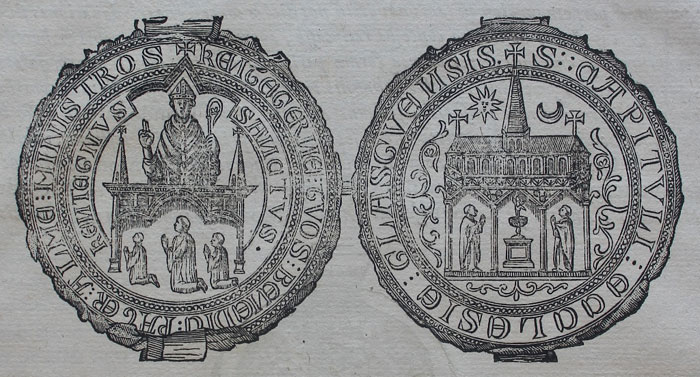
Jean Mabillon, Librorum De re diplomatica supplementum. In quo archetypa in his libris pro regulis proposita, ipsaeque regulae denuo confirmantur, novisque speciminibus & argumentis asseruntur & illustrantur. Opera & studio Domni Johannis Mabillon … (Paris, 1704), p. 109, detail. Illustrations of Scottish Seals from which Worth and his colleagues could take inspiration.
Amid all this benefaction, one question remains unanswered. Why did Worth provide in his Will for three catalogues of his library, given that he stipulated the library was only ‘for the use, benefit, and behoof of the Physitian (sic), Chaplain, and Surgeon for the time being’ at Steevens’ Hospital?[75] To what purpose then were the other two copies, one for Trinity College Library and the other for Marsh’s Library?[76] These latter copies effectively served as more publicly accessible catalogues, and, together with the catalogue in Dr Steevens’ Hospital, remain important for numismatic bibliography. Pearson notes that ‘There are several possible motives for printing such catalogues – vanity or pride, a wish to create a lasting memorial, the desire to further bibliographical or other studies …’.[77] Swift would have called it vanity. Yet if we set aside cynicism and recall Worth’s demonstrable interest in bibliography, we may have a good part of the explanation. Dekesels’ monumental ten-volume Bibliotheca Nummaria allows us to gauge the matter. Although Trinity and Marsh’s possess far larger collections, including Trinity’s vast Fagel Collection which was acquired in 1802, the much smaller library of Dr Worth at Dr Steevens’ Hospital is disproportionately strong in numismatics.[78] Much of Worth’s numismatic material is absent from Trinity and Marsh’s, highlighting the continued significance to modern researchers and numismatists of the Edward Worth Library.[79]
Text: David S. Dunlop, Independent Researcher | Bookbinder.
Member of Numismatic Society of Ireland – Northern Branch
Sources
Anon., ‘Population des villes européennes vers 1700’, [accessed 5 September 2026].
Anon., A catalogue of the antiquities of the late ingenious Mr. John Kemp, F.R.S., consisting Of Two of the Finest Mummies (esteem’d so by the Curious) that were ever brought from Egypt … (London, 1721).
Barrett, John, An Essay on the Earlier Part of the Life of Swift : To which are subjoined several pieces ascribed to Swift; two of his original letters; and extracts from his remarks on Bishop Burnet’s History (London, 1808).
Beaumont, Daniel, ‘Gilbert, Claudius‘, Dictionary of Irish Biography [accessed 5 September 2026].
Benson, Charles, ‘Some private libraries in early eighteenth-century Ireland’, in Westerhof, Danielle (ed.), The Alchemy of Medicine and Print : the Edward Worth Library, Dublin (Dublin, 2010), pp 48–56.
Boran, Elizabethanne, ‘The library of John Worth, 1648–1688: bookbinding and the book trade in late seventeenth-century Ireland’ (MA in Information and Library Management, University of Northumbria, 2009).
Boran, Elizabethanne, Aldines at the Edward Worth Library Dr Steevens’ Hospital, Dublin. A Descriptive Catalogue (Dublin, 2015).
Boran, Elizabethanne, ‘Buying and Selling Medical Books in Early Eighteenth-Century Dublin’, Eighteenth-Century Ireland / Iris an dá chultúr, 32, no. 1 (2017), 105–35.
Boran, Elizabethanne, ‘Dr Edward Worth: a connoisseur book collector in early eighteenth-century Dublin’, in Boran, Elizabethanne (ed.), Book Collecting in Ireland and Britain 1650–1850 (Dublin, 2018), pp 80–103.
Casey, Christine, Dublin : The City within the Grand and Royal Canals and the Circular Road with the Phoenix Park. Pevsner Architectural Guides : The Buildings of Ireland (New Haven, Conn. and London, 2005).
Chart, D. A., The Story of Dublin (London, 1907).
Clarke, M., Y. Desmond, and N. P. Hardiman (eds), Sir John T. Gilbert, 1829-1898 : Historian, Archivist and Librarian ; Papers and Letters Delivered During the Centenary Year, 1998 (Dublin, 1999).
Coakley, Davis, Doctor Steevens’ Hospital : a Brief History (Dublin, 1992).
Coakley, Davis, ‘Edward Worth and his library’, in Westerhof, Danielle (ed.), The Alchemy of Medicine and Print : the Edward Worth Library, Dublin (Dublin, 2010), pp 36–47.
Corporation, New Ross, Council Book of the Corporation of New Ross 1687 to 1732 Part 2.
Dekesel, Christian Edmond, and Yvette M. M. Dekesel-De Ruyck, Bibliotheca Nummaria III : Bibliography of 18th Century Numismatic Books ; Illustrated and Annotated Catalogue. Part I A-B & Indexes A-Z (London and Crestline, Calif., 2009).
Dibon, Paul, ‘Naples et L’Europe savante dans la second moitié du XVII siècle’, Nouvelles de la Republique des Lettres, 1 (1984), 27–45.
Fauske, Christopher J. (ed.) Archbishop William King and the Anglican Irish Context, 1688-1729 (Dublin, 2004).
Gilbert, Rosa Mulholland, Life of Sir John T. Gilbert, LL.D., F.S.A. : Irish Historian and Archivist, Vice-President of the Royal Irish Academy, Secretary of the Public Record Office of Ireland (London, 1905).
Haskell, F., History and its Images : Art and the Interpretation of the Past (New Haven, Conn. and London, 1993).
Ireland. Parliament. House of Commons, The Journals of the House of Commons, of the Kingdom of Ireland, From the Second to the Tenth Year of King George the First, viz. From 1715 to 1723, 2nd ed., 23 vols (Dublin, 1763), iv.
Ireland. Parliament. House of Commons, The Journals of the House of Commons, of the Kingdom of Ireland, From the Tenth Year of King George the First, to the Fifth Year of King George the Second, viz. From 1723 to 1731, 2nd ed., 23 vols (Dublin, 1763), v.
Jackson, Timothy R. (ed.), Frozen in Time : The Fagel Collection in the Library of Trinity College Dublin (Dublin, 2016).
Jordan, Thomas E., A Copper Farthing : Sir William Petty and His Times, 1623-1687 (Houghton-le-Spring, Sunderland, 2007).
Kelly, James, Sir Edward Newenham, MP, 1734-1814 : Defender of the Protestant Constitution (Dublin, 2004).
Kennedy, Máire, French Books in Eighteenth-Century Ireland (Oxford, 2001).
Kirkpatrick, T. P. C., The History of Doctor Steevens’ Hospital, Dublin, 1720-1920 (Dublin, 1924, reprinted 2008).
McCarthy, Muriel, ‘An Eighteenth Century Dublin Bibliophile’, Irish Arts Review, 3, no. 4 (1986), 29–35.
McCarthy, Patricia, Enjoying Claret in Georgian Ireland : A History of Amiable Excess (Dublin, 2022).
Moore, Sean D., Swift, the Book, and the Irish Financial Revolution : Satire and Sovereignty in Colonial Ireland (Baltimore, Md., 2010).
Murphy, Antoin E., The Genesis of Macroeconomics : new ideas from Sir William Petty to Henry Thornton (Oxford, 2009).
Nelson, Alan H., ‘The Life, Motto, and Library of William Walker (1570–1642), Vicar of Chiswick’, The Library, 27, no. 2 (2026), 189–208.
Nicolson, William, The Irish historical library. Pointing at most of the authors and records in print or manuscript, which may be serviceable to the compilers of a general history of Ireland. By William, Lord Bishop of Derry … (Dublin, 1724).
Turlough O’Riordain, ‘Edward Worth (c.1678–1733), MD and bibliophile’, Dictionary of Irish Biography (2009).
Pearson, David, Provenance Research in Book History : a Handbook (Oxford and New Castle, Del., 2019).
Robertson, Ritchie, The Enlightenment : The Pursuit of Happiness, 1680-1790 (London, 2022).
Swift, Jonathan, Irish Political Writings after 1725 : a Modest Proposal and Other Works edited by D. W. Hayton and Adam Rounce. The Cambridge Edition of the Works of Jonathan Swift,17 vols. (Cambridge, 2022), xiv.
Westerhof, Danielle (ed.), The Alchemy of Medicine and Print : the Edward Worth Library, Dublin (Dublin, 2010).
__
[1] Dekesel, Christian Edmond, and Yvette M. M. Dekesel-De Ruyck, Bibliotheca Nummaria III : Bibliography of 18th Century Numismatic Books ; Illustrated and Annotated Catalogue. Part I A-B & Indexes A-Z (London and Crestline, Calif., 2009), p. 5.
[2] McCarthy, Muriel, ‘An Eighteenth Century Dublin Bibliophile’, Irish Arts Review, 3, no. 4 (1986), 29.
[3] Kirkpatrick states the date of his death as 28 February 1733: Kirkpatrick, T. P. C., The History of Doctor Steevens’ Hospital, Dublin, 1720-1920 (Dublin, 1924, reprinted 2008), p. 60. Turlough O’Riordain, ‘Edward Worth (c.1678–1733), MD and bibliophile’, Dictionary of Irish Biography (2009), gives the date as 2 March 1733, [accessed 5 September 2026]. It is likely that the later date was the date of burial.
[4] Barrett, John, An Essay on the Earlier Part of the Life of Swift : To which are subjoined several pieces ascribed to Swift; two of his original letters; and extracts from his remarks on Bishop Burnet’s History (London, 1808), p. 114.
[5] Benson, Charles, ‘Some private libraries in early eighteenth-century Ireland’, in Westerhof, Danielle (ed.), The Alchemy of Medicine and Print : the Edward Worth Library, Dublin (Dublin, 2010), p. 49.
[6] Kirkpatrick, The History of Doctor Steevens’ Hospital, Dublin, p. 59.
[7] Anon., ‘Population des villes européennes vers 1700’ [accessed 5 September 2026].
[8] McCarthy, ‘An Eighteenth Century Dublin Bibliophile’, 29; Benson, ‘Some private libraries in early eighteenth-century Ireland’, p. 50.
[9] Coakley, Davis, Doctor Steevens’ Hospital : a Brief History (Dublin, 1992), p. 15.
[10] Ibid., p. 20. Sir Edward Lovett Pearce died on 7 December 1733; Casey, Christine, Dublin : The City within the Grand and Royal Canals and the Circular Road with the Phoenix Park. Pevsner Architectural Guides : The Buildings of Ireland (New Haven, Conn. and London, 2005), p. 683.
[11] Coakley, Doctor Steevens’ Hospital, p. 20.
[12] There is some confusion in the record but I believe some have confounded the date of death and the date of burial. The chronological order given seems to resolve the issue.
[13] Kirkpatrick, The History of Doctor Steevens’ Hospital, Dublin, p. 61.
[14] Ibid., p. 62.
[15] Ibid., p. 58.
[16] Ibid., p. 59.
[17] Westerhof, Danielle, ‘Introduction: the intellectual alchemy of medicine and print’, in Westerhof, Danielle (ed.), The Alchemy of Medicine and Print : the Edward Worth Library, Dublin (Dublin, 2010), p. 21.
[18] Gilbert’s Library (c.13,000 vols) was gifted to Trinity College as was his collection of coins and medals: Beaumont, Daniel, ‘Gilbert, Claudius‘, Dictionary of Irish Biography [accessed 5 September 2026]; Marsh’s Library (initially of c.10,000 vols), was established during his lifetime [accessed 5 September 2026].
[19] Registry of Deeds, Dublin (memorial 74, 145, 50436).
[20] Ibid.
[21] On the convoluted fate of John Worth’s books see Boran, Elizabethanne, ‘The library of John Worth, 1648–1688: bookbinding and the book trade in late seventeenth-century Ireland’ (MA in Information and Library Management, University of Northumbria, 2009).
[22] Registry of Deeds, Dublin (memorial 74, 145, 50436).
[23] Gilbert’s Library (c.13,000 vols) was gifted to Trinity College as was his collection of coins and medals: Beaumont, Daniel, ‘Gilbert, Claudius‘, Dictionary of Irish Biography [accessed 5 September 2026].
[24] Nicolson, John, A catalogue of books to be sold by the administrators of the reverend John Nicolson, late Rector of Donogh-more in the County of Donegal. (Being the library of the late Arch-Bishop of Cashel) (Dublin, 1729), Sig. H4v. The sales catalogue’s reference to the catalogue ‘being the library of the late Archbishop of Cashel’ identifies the library as being that of John’s father, William Nicolson. As the estate sale was issued ‘by the administrators of the reverend John Nicolson’, the catalogue may also include some items belonging to John Nicolson.
[25] Nicolson, William, The Irish historical library. Pointing at most of the authors and records in print or manuscript, which may be serviceable to the compilers of a general history of Ireland. By William, Lord Bishop of Derry … (Dublin, 1724), pp 154–75.
[26] Last Will and Testament, appended to a Codicil dated 5 November 1729, ‘My Executor will find in my iron chest ten pieces of Gold (amounting to fifty Guineas in value) which I have given to Mrs Nutley, and which I have desire him to deliver to here (sic) as my Gift. E. Worth’: Registry of Deeds, Dublin (memorial 74, 145, 50436).
[27] Ibid.
[28] This is a marked-up sales catalogue of Dr Worth’s with coins and other collectibles for sale, not simply books.
[29] Anon., A catalogue of the antiquities of the late ingenious Mr. John Kemp, F.R.S., consisting Of Two of the Finest Mummies (esteem’d so by the Curious) that were ever brought from Egypt … (London, 1721), title page.
[30] Kirkpatrick, The History of Doctor Steevens’ Hospital, Dublin, p. 64.
[31] McCarthy, Muriel, ‘An Eighteenth Century Dublin Bibliophile’, 29, 31.
[32] Coakley, Doctor Steevens’ Hospital, p. 20.
[33] Kelly, James, Sir Edward Newenham, MP, 1734–1814 : Defender of the Protestant Constitution (Dublin, 2004), p. 25; Michael Lyons, ‘Foreword’, in Westerhof, Danielle (ed.), The Alchemy of Medicine and Print : the Edward Worth Library, Dublin (Dublin, 2010), p. 11.
[34] Boran, Elizabethanne, Aldines at the Edward Worth Library Dr Steevens’ Hospital, Dublin. A Descriptive Catalogue (Dublin, 2015), p. xii. See also Boran, Elizabethanne, ‘Dr Edward Worth: a connoisseur book collector in early eighteenth-century Dublin’, in Boran, Elizabethanne (ed.), Book Collecting in Ireland and Britain 1650–1850 (Dublin, 2018), p. 82.
[35] Kelly, James, Sir Edward Newenham, MP, 1734–1814, p. 20.
[36] Kennedy, Máire, French Books in Eighteenth-Century Ireland (Oxford, 2001), p. 63, states that ‘In 1724 Dr Edward Worth purchased forty-four volumes at the auction of the library of Louis-Henri de Loménie, comte de Brienne’ citing McCarthy, ‘An Eighteenth Century Dublin Bibliophile’, pp 29–33. The library catalogue is showing forty-eight, though there are questions raised by a bibliographer against a few. Worth’s 1730 purchase at the Huls auction netted six of numismatic interest.
[37] This role had originally been strictly engaged in financial matters but by the early modern period had expanded in remit, though it still was involved in matters of revenue.
[38] See, for example, Westerhof’s comment, ‘Although the relatively pristine state of the library suggests that we have to be careful not to assume that Worth actually read all the books he purchased’: Westerhof, ‘Introduction: the intellectual alchemy of medicine and print’, p. 20.
[39] David Hayton (Queen’s University Belfast), in a lecture, ‘The Culture of Politics in Irish Parliamentary Boroughs 1690-1760’, given to The Royal Society of Antiquaries of Ireland, Merrion Square, Dublin, 23 April 2026.
[40] Corporation, New Ross, Council Book of the Corporation of New Ross 1687 to 1732 Part 2, fol. 303 [236v].
[41] Worth appeared for the first time in the record, Ireland. Parliament. House of Commons, The Journals of the House of Commons, of the Kingdom of Ireland, From the Second to the Tenth Year of King George the First, viz. From 1715 to 1723, 2nd ed., 23 vols (Dublin, 1763), iv, p. 10.
[42] David Hayton (QUB), in a lecture, ‘The Culture of Politics in Irish Parliamentary Boroughs 1690-1760’, given to The Royal Society of Antiquaries of Ireland, Merrion Square, Dublin, 23 April 2026.
[43] One inscription from the Worth Library may be found on A collection of the severall acts, ordinances, & orders as well of Parliament as of His Highness the Lord Protector (now in force) for the levying of monies by way of excise and nevv-impost. Together with severall orders of the Council, the commissioners for appeals and regulating the excise, &c. relating to the management thereof (London, 1655). While this text was published within the lifetimes of Worth’s father and grandfather, it does not bear his father’s characteristic signature and instead, on the front free endpaper of the sammelband of five pamphlets, we find the following inscription: ‘William R Dewey, 1692’. Another sammelband of twenty-eight interregnum pamphlets has an inscription, ‘Henry Frayne Booke bought the first of June 1710’ – clearly, Worth purchased the text at some point after this this date. [see An Act for an assessment upon England, at the rate of sixty thousand pounds by the moneth, for three moneths; from the twenty fifth day of March 1657. to the twenty fourth day of June then next ensuing. At the Parliament begun at Westminster, the 17th day of September, an. Dom. 1656 (London, 1657)]. A third sammelband of thirty-six publications, beginning with The report of the commissioners appointed by Parliament to enquire into the Irish forfeitures, deliver’d to the honble House of Commons the 15th of December, 1699. With their resolutions and addresses to His Majesty relating to those forfeitures. As also His Majesty gracious answers thereunto; and his most gracious speech to both Houses of Parliament the 5th of January, 1690 (Dublin, 1700), contains material mainly relating to economics and Ireland, which was put together in the early 1700s: again none of these items were inherited.
[44] Evidence for the date of commencement has not been stated. Based on the annotated endpapers in the sammelbands, in the Edward Worth Library, here mentioned, it may be more likely that the collection was commenced in the early eighteenth century. On this see Clarke, M., Y. Desmond, and N. P. Hardiman (eds), Sir John T. Gilbert, 1829-1898 : Historian, Archivist and Librarian ; Papers and Letters Delivered During the Centenary Year, 1998 (Dublin, 1999), p. 66.
[45] Dibon, Paul, ‘Naples et L’Europe savante dans la second moitié du XVII Siècle’, Nouvelles de la Republique des Lettres, 1 (1984), 43, 44.
[46] Ireland. Parliament. House of Commons, The Journals of the House of Commons, of the Kingdom of Ireland, From the Second to the Tenth Year of King George the First, viz. From 1715 to 1723, 2nd ed., 23 vols (Dublin, 1763), iv, p. 703: ‘Ordered , that leave be given to bring in heads of a bill to oblige ships coming from infected places more effectually to perform their quarantine (sic), and for the better preventing of the plague being brought from foreign parts into this Kingdom, and that Mr. Plunket, Mr. Forth, Mr. Tighe, Doctor Trotter, Doctor Worth, Mr. Ward, Mr. Rose, Mr. Serjeant Brodrick, Mr. Samuel Bindon, and Mr. Ivers, do prepare and bring in the same’.
[47] Contrary to Benson’s assertion that ‘The Irish economy entered a new phase of growth in the decades following the final defeat of the Jacobite cause…’: ‘Some private libraries in early eighteenth-century Ireland’, p. 49, David Hayton considers that economic ‘development was slow, with chronic depression and recurrent crises’ from the early 1690s until c. 1730: Private correspondence with author, 1 September 2026. He states that ‘Economic historians have identified the 1740s as the decade in which the Irish economy finally ‘took off’: see Hayton, D. W., and Adam Rounce (eds), Irish Political Writings after 1725 : a Modest Proposal and Other Works. The Cambridge Edition of the Works of Jonathan Swift, 17 vols (Cambridge, 2022), xiv, p. xxxvii. For relevant sammelbands see Edward Worth Library Modern Control Numbers 1452, 2150 and 2156 respectively.
[48] Ireland. Parliament. House of Commons, The Journals of the House of Commons, of the Kingdom of Ireland, From the Second to the Tenth Year of King George the First, viz. From 1715 to 1723, 2nd ed., 23 vols (Dublin, 1763), iv, p. 310.
[49] Ibid., p. 709.
[50] Ibid., pp 709, 710.
[51] Ibid., p. 710. The date given is ‘1719’, but this is clearly a printer’s error, and should read ‘1721’, as the context before and after demonstrates.
[52] Ibid., p. 711.
[53] Ibid., pp 715 and 723.
[54] Ireland. Parliament. House of Commons, The Journals of the House of Commons, of the Kingdom of Ireland, From the Tenth Year of King George the First, to the Fifth Year of King George the Second, viz. From 1723 to 1731, 2nd ed., 23 vols (Dublin, 1763), v, p. 17.
[55] Ibid., p. 22.
[56] Ibid., pp 20, 21.
[57] Registry of Deeds, Dublin (memorial 74, 145, 50436). Worth’s will was dated 11 November 1723, with a codicil added 5 November 1729.
[58] Ibid.
[59] Coakley suggests that Worth was the convenor of the committee, but, while this is probable, it is not definite: Coakley, Davis, ‘Edward Worth and his library’, in Westerhof, Danielle (ed.), The Alchemy of Medicine and Print : the Edward Worth Library, Dublin (Dublin, 2010), p. 42. Kirkpatrick is more non-committal on Worth’s role: ‘It was decided that three of the Governors, of whom Dr. Worth should be one, were to form a committee to meet at Dr. Worth’s chambers ‘to consider of a seal for the Corporation’: Kirkpatrick, The History of Doctor Steevens’ Hospital, Dublin, p. 44.
[60] Chart, D. A., The Story of Dublin (London, 1907), p. 273.
[61] Registry of Deeds, Dublin (memorial 74, 145, 50436).
[62] Samuel Huls’ sale catalogue was later marked up in the relevant numismatic sections with the prices paid. See, for example Johannes Swart and Pieter De Hondt, Bibliotheca Hulsiana, sive catalogus librorum … collegit Samuel Hulsius … Quorum auctio habebitur Hagae-Comitum..die 4. Septemb. & sequentibus 1730, 3 vols (The Hague, 1730), i, pp 180-183, which includes the following items: item no. 2916, which was a sammelband of three items by Paul Petau (1568–1614); item no. 2922 which was Angelo Gabriello Anguissola’s Della Hebraica medaglia detta Maghen David et Abraam. Dichiaratione de Don Angelo Gabriello Anguissola (Milan, 1617); item no. 2927 which was Marc Maier’s Il regno di Napoli e di Calabria, descritto con medaglie arrichito d’una descrittione compendiosa di quel famoso regno … Cavata da i più celebri ed approvati scrittori si antichi come moderni da Marco Maier (Lyon, 1717); and item no. 2933, which was Johann Jakob Luckh, Sylloge numismatum elegantiorum quae diuersi impp: reges, principes comites, respublicae diuersas ob causas ab anno 1500 ad annum usq; 1600 cudi fecerunt concinnata & historica narratione … illustrata opera ac studio Ioannis Iacobi Luckii … (Strassbourg, 1620). See also an annotated letter from William Smith III, Worth’s agent for the Bibliotheca Uilenbroukiana Sale, Amsterdam, 1729: Edward Worth Library MS P/1/10.
[63] In addition to those already mentioned, Worth purchased the following items from the Huls sale: Cesare Antonio Vergara, Monete del regno di Napoli da Roggiero Primo Ré, sino all’ augustissimo Regnante Carlo VI … (Rome, 1716); and Georg Agricola, Georgii Agricolae De mensuris & ponderibus Romanorum atque Graecorum lib. V De externis mensuris … lib.II Ad ea, quae Andreas Alciatus denuo disputauit …, breuis defensio lib. I De mensuris … lib.I De restituendis ponderibus atq; mensuris lib. I De precio metallorum & monetis lib. II (Basle, 1550).
[64] Kirkpatrick, The History of Doctor Steevens’ Hospital, Dublin, p. 65.
[65] On the bindings, scope and fate of John Worth’s collection see Boran, ‘The library of John Worth, 1648–1688: bookbinding and the book trade in late seventeenth-century Ireland’ (2009).
[66] Only one work of Swift’s appears in the Worth Library, his edition of The works of Sir William Temple … In two volumes … To which is prefix’d some account of the life and writings of the author (London, 1720). Interestingly, among the numismatic content of that work is ‘An Essay on the Advancement of Trade in Ireland’ (1673); For a treatment of William King’s works, see Fauske, Christopher J. (ed.) Archbishop William King and the Anglican Irish Context, 1688-1729 (Dublin, 2004) especially chapters by McNally, Richardson, and Reilly.
[67] Hayton, D. W., and Adam Rounce (eds), Irish Political Writings after 1725, pp 214–16.
[68] Robertson, Ritchie, The Enlightenment : The Pursuit of Happiness, 1680-1790 (London, 2022), p. 401; See also Gulliver’s Travels, Bk. III, and, Reilly’s chapter on ‘William King and the idea of ‘improvement’ in Fauske (ed.) Archbishop William King and the Anglican Irish Context, 1688-1729, pp 148-159.
[69] See ‘Dekesel Categorisations’ for the rationale for inclusion in the list.
[70] For further treatment of Petty, see Jordan, Thomas E., A Copper Farthing : Sir William Petty and His Times, 1623-1687 (Houghton-le-Spring, Sunderland, 2007), especially Chapter 5, ‘Petty’s Ireland’, and Chapter 6, ‘The Down Survey, Writings, and Inventions’.
[71] Murphy, Antoin E., The Genesis of Macroeconomics : new ideas from Sir William Petty to Henry Thornton (Oxford, 2009), p. 2.
[72] Ibid., p. 215.
[73] Worth owned two editions of Graunt’s Natural and political observations mentioned in a following index, and made upon the bills of mortality. By Capt. John Graunt … With reference to the government, religion, trade, growth, air, diseases, and the several changes of the said city … (London, 1665 and 1676).
[74] Registry of Deeds, Dublin (memorial 74, 145, 50436).
[75] Ibid.
[76] Trinity College Dublin, MS 12 and Marsh’s Library, MS Z2.1.9.
[77] Pearson, David, Provenance Research in Book History : a Handbook (Oxford and New Castle, Del., 2019), p. 221.
[78] See, for example, Jackson, Timothy R. (ed.), Frozen in Time : The Fagel Collection in the Library of Trinity College Dublin (Dublin, 2016).
[79] This is an area of research still ongoing, and it would be premature to give even tentative statistics, but the statement above is based on a largely-complete survey of Dekesel’s entries for TCD and Marsh’s across the three centuries under review; Dekesel’s bibliography incorporated a survey of the Trinity and Marsh Collections.