Home
The Edward Worth Library is a rare books collection, bequeathed to Dr Steevens’ Hospital, Dublin, by Dr Edward Worth (1676–1733), who was one of the Hospital’s earliest Trustees. This web exhibition celebrates Worth’s extensive collection of numismatic texts and was curated by Dr Elizabethanne Boran, the Librarian of the Edward Worth Library, and Mr David S. Dunlop, Independent Researcher, Bookbinder and Member of the Numismatic Society of Ireland – Northern Branch; with photographic contributions from Mr Antoine Mac Gaoithín (Worth Library staff). It is the twentieth in a series of websites exploring the holdings of the Worth Library. For further details please contact our website: https://edwardworthlibrary.ie/.
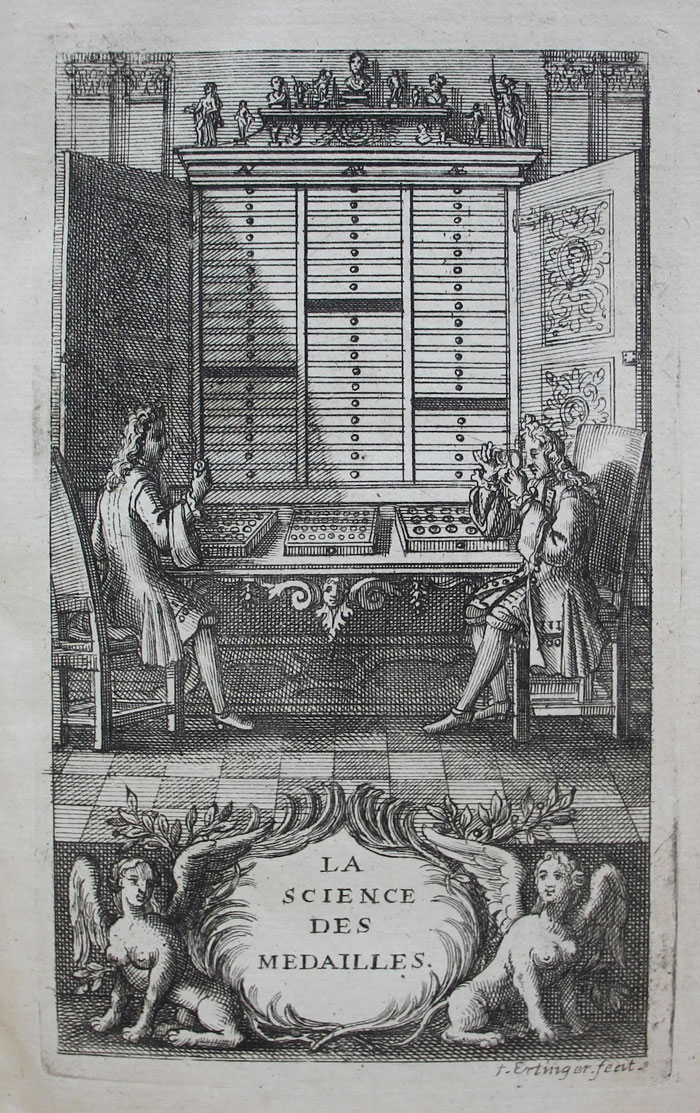
Louis Jobert, La science des médailles pour l’instruction de ceux, principalement qui commencent a s’appliquer a la connoissance des médailles antiques, et modernes … (Paris, 1715), engraved title page.
Worth was clearly a very interested collector of numismatic texts in all their forms and his extensive numismatic collection offers readers a tour of some of the most important writers on numismatics in the sixteenth, seventeenth and early eighteenth centuries. Leading commentators on numismatic collections in sixteenth-century Europe included the Italian antiquarian Jacopo Strada (c. 1515–88); the painter, engraver, printer and numismatist Hubert Goltzius (1526–83), who became famous for, among other things, drawing up a list of contemporary collectors; and Fulvio Orsini (1529–1600), who was well-placed in Rome to aid his patron Cardinal Alessandro Farnese (1520–89), in his quest for numismatic treasures.
The seventeenth century witnessed the rise of the French commentators, leading numismatists such as Charles Patin (1633–93) and Jean Foy-Vaillant (1632–1706), each heavily influenced by the machinations of the Sun King himself, Louis XIV (1638–1715). Louis XIV was not the only monarch to utilise numismatics as a tool of propaganda: German princes sought to build up their collections and Lorenz Beger (1653–1705), a German librarian, would play an important role at both Heidelberg and Brandenburg. This trend was continued into the early eighteenth century as witnessed by the Gotha collections described by Christian Sigismund Liebe (1687–1736). Zeal for numismatic collecting had also been rising in Scandinavia and Worth was keen to acquire material by Nils (Nicolas) Keder (1659–1735), who had been given the task of cataloguing the royal Swedish collections. As his multi-volume set by Paolo Pedrusi (1644–1720), which sought to glorify the dukes of Parma and Piacenza, demonstrates, Worth also continued his interest in Italian collections.
In all, Mr Dunlop has identified 402 works of numismatic relevance – almost a tenth of Worth’s entire collection – covering all the Dekesel categories. The Dekesels (twenty-first century bibliographers), spread their net wide, including a host of material, and have provided numismatists with an overarching categorization which is now undoubtedly the standard reference work. As Mr Dunlop has noted, Worth too cast his net wide. Nor did he neglect literature about coins minted in Ireland for among the coins described by Keder are ones dating to the Viking period. To find out more about these and later Irish collections see the National Museum’s exhibition ‘Airgead: A Thousand Years of Irish Coins & Currency’, as well as the website of the Numismatic Society of Ireland. We hope that our exhibition highlights the fact that the Worth Library is a vital resource for all historians of early modern numismatics.