Charles Patin in Paris and Padua
‘An immortal glory is borne to Patin, who submerged the labors of Ursinus in his own’.
Louis-Henri de Loménie (1635–98), Comte de Brienne, 1663.[1]
This quotation, from Louis-Henri de Loménie (1635–98), Comte de Brienne, was included in Patin’s 1663 edition of Fulvio Orsini’s Familiae Romanae in antiquis numismatibus, ab urbe condita, ad tempora divi Augusti … (Paris, 1663), which Worth possibly bought at the sale of Loménie de Brienne’s library in 1724.[2] Worth definitely acquired his first edition of Familiae Romanae quae reperiuntur in antiquis numismatibus ab urbe condita ad tempora divi Augusti ex bibliotheca Fulvi Vrsini Adiunctis familiis XXX ex libro Antoni Augustini which Orsini (1529–1600), published at Rome in 1577, from Brienne’s library, paying £1 and 1 shilling for it.[3] Brienne was not alone in his estimation of Patin’s skills as a numismatist – Louis Jobert (1637–1719), called him ‘one of the most famous Antiquaries of our Age’.[4]
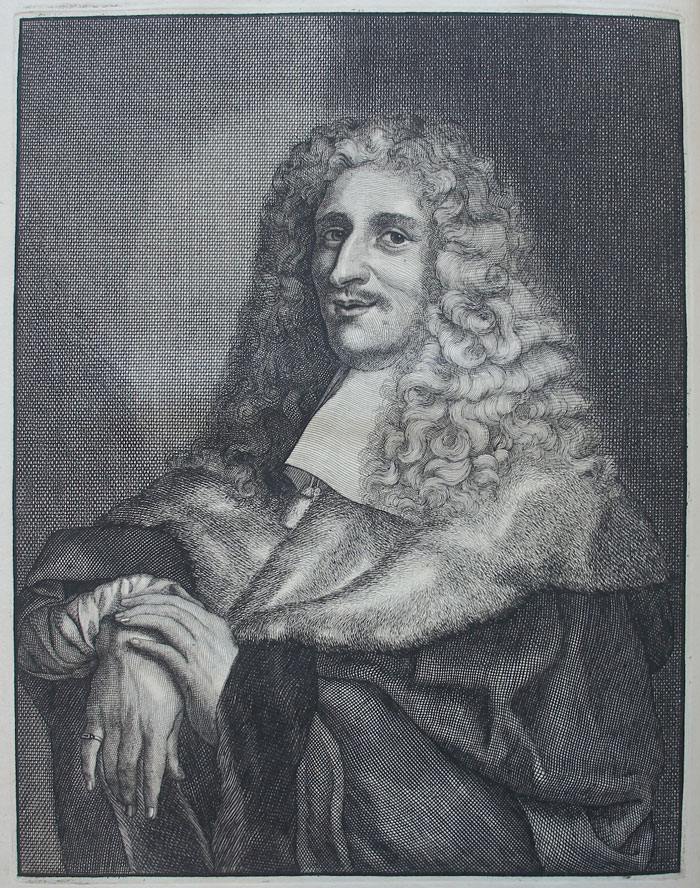
Charles Patin, Imperatorum romanorum numismata ex ære, mediæ et minimæ formæ: descripta & enarrata per Carolum Patinum (Amsterdam, 1697), frontispiece portrait of Charles Patin (1633–93).
Charles Patin had a rather tumultuous career. The third son of the famous French physician Guy Patin (1601–72), he had shone at his Jesuit school and though initially tempted to study law decided to follow his father into the medical profession.[5] He was involved in the publication of Louis-Henri de Loménie’s travel journal in 1662 and soon began to produce works relating to his passion: numismatics.[6] Unfortunately, this is where his career, which previously had been rather stellar, began to take a turn for the worse, for his 1665 text Introduction à l’histoire par la connoissance des médailles (Paris, 1665), was accused of plagiarising an earlier work by Louis Savot (c. 1579–1640), whose Discours sur les médailles antiques de Louis Savot had been published in 1627.[7] Unfortunately for Patin, the scholar who made the accusation, Jean Denis de Sallo (1626–69), Sieur de La Couldraye, was the founder of the Journal des Sçavans, and more particularly, had friends in high places. As Guy Patin warned his son, ‘La vérite est que M. Colbert prend en sa protection les auteurs de ce journal … La République des lettres est pour nous, mais M. Colbert est pour eux’.[8] Jean Baptist Colbert (1619–1683), the finance minister of Louis XIV (1638–1715), King of France, was a power in the land, and one who took an active interest in the Parisian book trade. The fact that Charles Patin was also involved in importing clandestine books – a practice which Colbert and his colleagues were anxious to stamp out – meant that Patin’s position was becoming increasingly untenable. In 1667 he was condemned to the galleys but fled to Heidelberg to escape the sentence. From Heidelberg, he travelled widely across Europe, visiting numismatic collections, before being offered a chair of medicine at the University of Padua in 1676.[9]
Padua certainly proved to be a congenial place for him: he attended the presentation of a doctorate to Elena Lucrezia Cornaro Piscopia (1646–84), the first woman to be awarded a doctorate in philosophy. Patin certainly approved for he had married the moralist Madeleine Patin (1640?–1722), and both parents took a keen interest in the education of their daughters: Charlotte-Catherine (1666–1744), who became a writer and art critic, and Gabrielle-Charlotte (1666–1751), who subsequently followed in her father’s footsteps by publishing works on numismatics. All four of the family became members of Accademia galileiana di scienze, lettere ed arti in Padova. When Louis XIV finally relented by offering Patin a pardon in 1681, Patin refused it on the grounds that he had committed no crime, and he opted to stay in Padua.
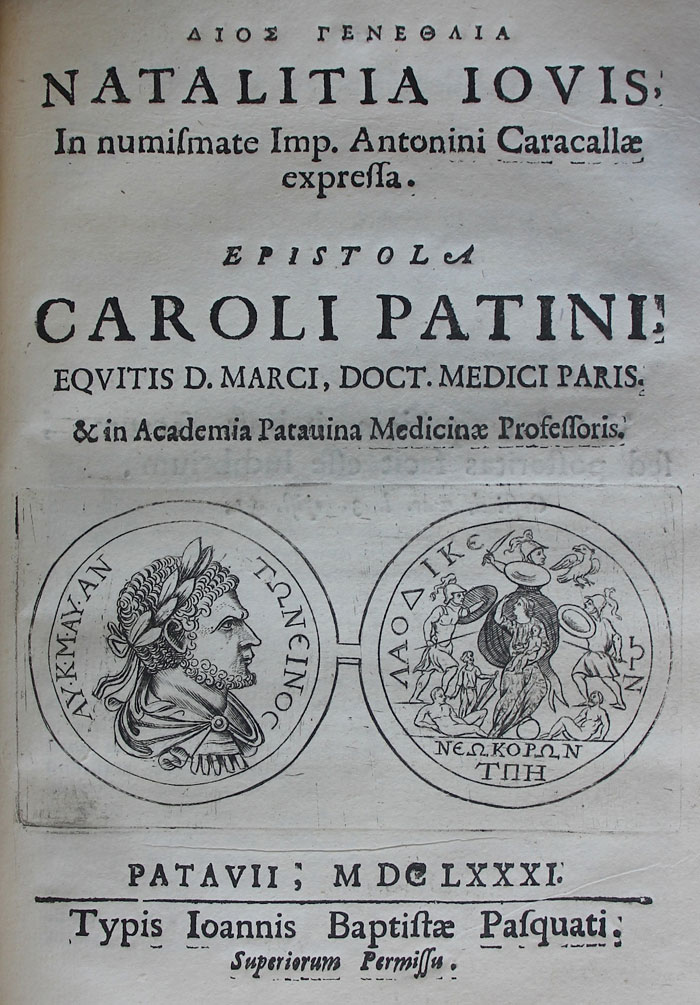
Charles Patin, Dios genethlia. Natalitia Iovis, in numismate Imp. Antonini Caracallæ expressa : epistola C. Patini … (Padua, 1681), title page.
Patin not only travelled widely, he also maintained an extensive correspondence with other numismatic collectors. Callegari has investigated one node in his network, the correspondence he began in 1679 with the Italian scholar and nobleman Giulio Antonio Averoldi (1651–1717), who was based in Brescia.[10] Callegari notes that Averoldi was known for his interest in Roman inscriptions and was visited not only by Patin but also by Jean Foy-Vaillant (1632–1706), and other leading numismatists.[11] In 1687 Averoldi published a translation of Pierre Rainssant’s work on the medals of Domitian (Worth did not purchase this). He was thus interested in both coins and medals – and Patin was keen to supply him with both. In his initial letter to Averoldi, dated 1 January 1679, Patin warned Averoldi against unscrupulous dealers and offered his own services, asking him to send a catalogue of his current coin and medal collections so that Patin would know what he lacked.[12] Unfortunately, Averoldi did not take a tally of his collection and his collection was later sold but Callegari suggests that a later inventory probably reflects Averoldi’s holdings.[13] If so it was an extensive collection of 2,537 coins and medals, with 196 Roman Republican denarii, 502 Roman Imperial denarii but also more modern items, such as 167 silver medals of Louis XIV.[14] Patin was able to advise him on both the rarity of some of his coins – and also break the bad news that others were fakes.[15] In addition, Patin provided Averoldi with books (and not just his own publications)![16]
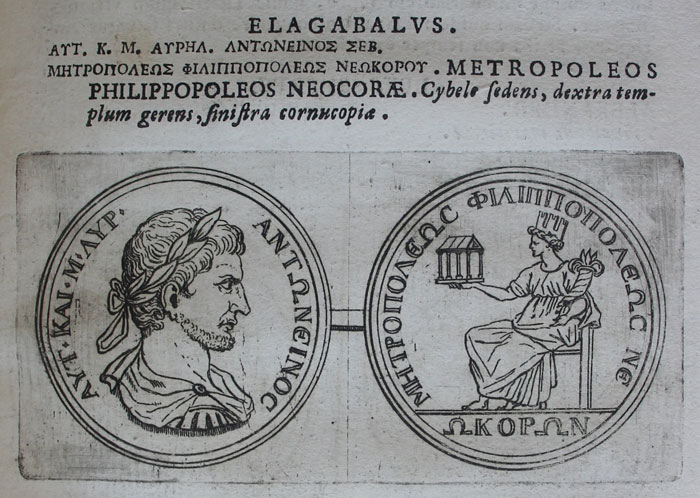
Charles Patin, Thesaurus numismatum, antiquorum & recentiorum, ex auro, argento, & aere, ab … Petro Mauroceno, … 1683 (Venice, 1683), p. 79, detail: coin of Elagabulus (204–222), Emperor of Rome.
Not all numismatic scholars viewed Patin with the same esteem as Averoldi: the Swiss numismatist, Andreas Morell (1646–1703), had his doubts about Patin’s integrity and commented unfavourably on him in his extensive correspondence, a correspondence which included collectors such as Sir Andrew Fountaine (1676–1753), and Prince Joseph-Charles-Procope de Ligne (1661–1713). Worth collected texts by both Morell and Fountaine for Fountaine’s seminal text on British numismatics, Numismata Anglo-Saconica et Anglo-Danica breviter illustrata, formed part of his copy of George Hickes’ Linguarum vett. septentrionalium thesaurus grammatico-criticus et archaeologicus (Oxford, 1705), and he also owned Morell’s Specimen universæ rei nummariæ antiquæ quod literatorum reipublicæ proponit (Paris, 1683), along with an epistolary exchange between Morell and Jacobus Perizonius (1651–1715). De Ligne took a keen interest in numismatics and bought part of Patin’s collection after the latter’s death in 1693. He must therefore have been dismayed to hear from Morell in 1702 that the latter thought that Patin had fabricated modern coins to make them look like antiques.[17]
An unfavourable review by Morell was certainly damaging because, as De Callatay notes, Morell was an influential node in the numismatic Republic of Letters.[18] He was an ambitious man who had initially impressed the court at Versailles with his knowledge of coins but who, like Patin, fell foul of the regime and, in his case, was imprisoned for some years before fleeing to Arnstadt where he became a librarian. As part of his position there he took charge of the numismatic collection of Anton Günther II (1653–1716), Count of Schwarzburg-Sondershausen-Arnstadt, a wonderful collection which would later be explored by Christian Sigismund Liebe (1687–1736). Morell, it should be noted, was not just caustic about Patin – he and Fountaine also disparaged the numismatic publications of Lorenz Beger (1653–1705).[19]
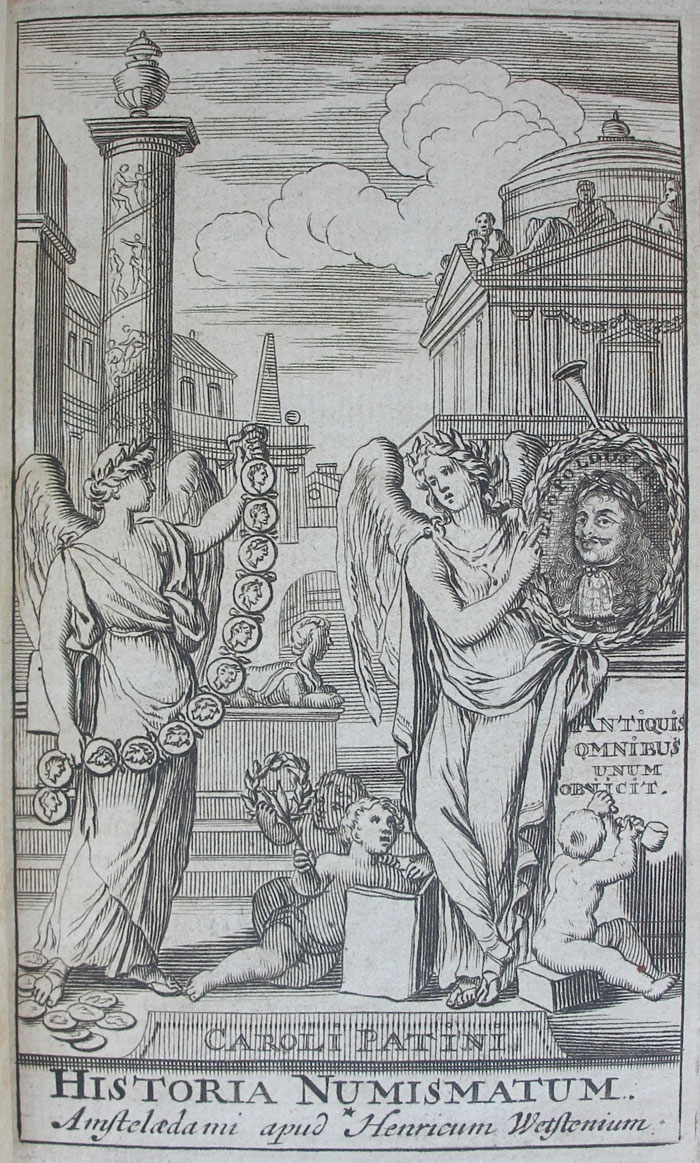
Charles Patin, Introductio ad historiam numismatum … (Amsterdam, 1683), title page.
Other numismatists were considerably more impressed by Patin’s many publications. Jobert, who was himself engaged in writing a textbook on La science des médailles, which appeared in French in 1692 and which Worth purchased in both an English 1697 and a French 1715 edition, pointed to Patin’s role in explaining numismatics to readers: ‘He has laid an Eternal Obligation upon the World, for having inspired a-new into the Learned, the Esteem and Love of Medals, and facilitating the understanding them, by the many brave Discourses he has publish’d in order to unfold their Mysteries’.[20] Jobert’s respect for Patin shines through his textbook – he draws attention not only to Patin’s own collections but also his important pedagogical role in explaining his collection of imperial coins, a collection which included coins previously belonging to Louis-Henri de Loménie: ‘M. Patin has not only been at the trouble of collecting a great many of them, but has engraven all his middle Copper ones, and has endeavoured to explain them more amply and successfully than all that have gone before him’.[21] In Jobert’s view, any numismatist interested in the coins of Roman families need look no further than Patin’s enlarged edition of Fulvio Orsini’s Familiae Romanae in antiquis numismatibus, ab urbe condita, ad tempora divi Augusti. Ex bibliotheca Fulvii Ursini, cum adjunctis Antonij Augustini … Carolus Patin … restituit, recognovit, auxit (Paris, 1663). Evidently Worth agreed, for he too purchased this edition.
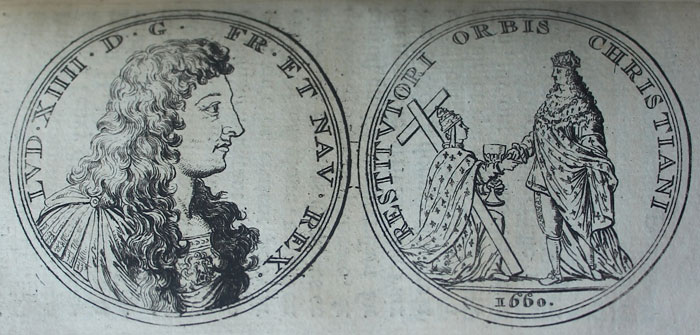
Charles Patin, Histoire des medailles; ou, Introduction a la connoissance de cette science (Paris, 1695), p. 122: medal depicting Louis XIV (1638–1715), King of France.
John Evelyn (1620–1706), concurred, noting that Patin’s edition of Orsini was ‘as most accurate of any for likeness to the original Sculps and Design’.[22] For Evelyn, whose Numismata. A discourse of medals, antient and modern was published in the same year as Worth’s English translation of Jobert, and which was likewise acquired by Worth, anyone interested in the study of numismatics would be well advised to follow the ‘Advice and Directions of the Learned and Industrious Patin’.[23]
Text: Dr Elizabethanne Boran, Librarian of the Edward Worth Library, Dublin.
Sources
Callatay, François de, ‘Sir Andrew Fountaine (1676–1753) and his early numismatic correspondence with Andreas Morell (1646–1703), in Bland, Roger, and Dario Calomino (eds), Studies in Ancient Coinage in Honour of Andrew Burnett (London, 2015), pp 293–316.
Callatay, François de, ‘La mauvaise réputation de Charles Patin (1633–1693) numismate d’après des correspondances de tiers (Nicolò Bon, Andreas Morell et Joseph-Charles-Procope de Ligne)’, in Asolati, Michele, et al. (eds), Suadente nummo vetere: Studi in onore di Giovanni Gorini (Padua, 2016), pp 369–79.
Callegari, Marco, ‘About Books and Coins: The Letters of Charles Patin to Giulio Antonio Averoldi between 1679 and 1693’, in Callatay, François de (ed.), Numismatic Antiquarianism through Correspondence (16th–18th c.): In the Margin of the Project Fontes Inediti Numismaticae Antiquae (FINA) (New York, 2023), pp 189–205.
Evelyn, John, Numismata. A discourse of medals, antient and modern (London, 1697).
Ferté, Patrick, ‘De Paris à Padoue, le grand tour d’un universitaire proscrit par Lous XIV : Charles Patin, médicin, numismate (1633–1693)’, Les Cahiers de Framespa, 6, (2010) [accessed 20 August 2026].
Hassett, Ella, ‘Charles Patin : Coins and Condemnation’, Edward Worth Library online exhibition [accessed 24 August 2026].
Morris, Robert, ‘A Noble Testimony to Numismatic Science’, American Journal of Numismatics, and Bulletin of the American Numismatic and Archaeological Society, 11, no. 2 (1876), 31–3.
Rambach, Hadrien, ‘La controverse Louis Savot – Charles Patin, numismates du XVIIème siècle’, Schweizer Münzblätter, 231 (2008), 71–5.
Woodman, James, and David Lyon, Illustrissimi & excellentissimi Ludovici Henrici, Comitis Castri-Briennij … bibliothecae, ad ejusdem filium Constantiae in Normannia episcopum pertinentis, catalogus. A catalogue of the library of his excellency Louis Henry de Lomenie, Count de Brienne … to be sold … the 28th of April, 1724 (London, 1724).
__
[1] Morris, Robert, ‘A Noble Testimony to Numismatic Science’, American Journal of Numismatics, and Bulletin of the American Numismatic and Archaeological Society, 11, no. 2 (1876), 33.
[2] Woodman, James, and David Lyon, Illustrissimi & excellentissimi Ludovici Henrici, Comitis Castri-Briennij … bibliothecae, ad ejusdem filium Constantiae in Normannia episcopum pertinentis, catalogus. A catalogue of the library of his excellency Louis Henry de Lomenie, Count de Brienne … to be sold … the 28th of April, 1724 (London, 1724), p. 41, no. 610: Marked with a question mark and squiggle.
[3] Ibid., p. 43, no. 629.
[4] Jobert, Louis, The knowledge of medals, or, Instructions for those who apply themselves to the study of medals both ancient and modern from the French (London, 1697), p. 16.
[5] Ferté, Patrick, ‘De Paris à Padoue, le grand tour d’un universitaire proscrit par Lous XIV : Charles Patin, médicin, numismate (1633–1693)’, Les Cahiers de Framespa, 6, (2010), paragraphs 11–13 [accessed 20 August 2026].
[6] Ibid., paragraph 13.
[7] Rambach notes that Christian E. Dekesel concluded that Patin had not plagiarised Savot’s work: Rambach, Hadrien, ‘La controverse Louis Savot – Charles Patin, numismates du XVIIème siècle’, Schweizer Münzblätter, 231 (2008), 73.
[8] Ferté, ‘De Paris à Padoue, le grand tour d’un universitaire proscrit par Lous XIV : Charles Patin, médicin, numismate (1633–1693)’, paragraph 15.
[9] On Patin’s academic contacts during these travels see Ferté’s article.
[10] On this see Callegari, Marco, ‘About Books and Coins: The Letters of Charles Patin to Giulio Antonio Averoldi between 1679 and 1693’, in Callatay, François de (ed.), Numismatic Antiquarianism through Correspondence (16th–18th c.): In the Margin of the Project Fontes Inediti Numismaticae Antiquae (FINA) (New York, 2023), pp 189–205.
[11] Ibid., p. 190.
[12] Ibid., p. 191.
[13] Ibid.
[14] Ibid.
[15] Ibid., p. 192.
[16] Ibid., p. 196.
[17] Callatay, François de, ‘La mauvaise réputation de Charles Patin (1633–1693) numismate d’après des correspondances de tiers (Nicolò Bon, Andreas Morell et Joseph-Charles-Procope de Ligne)’, in Asolati, Michele, et al. (eds), Suadente nummo vetere: Studi in onore di Giovanni Gorini (Padua, 2016), p. 374.
[18] Callatay, François de, ‘Sir Andrew Fountaine (1676–1753) and his early numismatic correspondence with Andreas Morell (1646–1703), in Bland, Roger, and Dario Calomino (eds), Studies in Ancient Coinage in Honour of Andrew Burnett (London, 2015), p. 298.
[19] On this see Callatay, François de, ‘Sir Andrew Fountaine (1676–1753) and his early numismatic correspondence with Andreas Morell (1646–1703)’, pp 299, 307.
[20] Jobert, Louis, The knowledge of medals, or, Instructions for those who apply themselves to the study of medals both ancient and modern from the French (London, 1697), p. 17.
[21] Ibid., p. 45.
[22] Evelyn, John, Numismata. A discourse of medals, antient and modern (London, 1697), p. 241.
[23] Ibid., p. 244.