Sixteenth-Century Collections
‘They buy up everything indiscriminately at enormous prices, they compete with each other over numbers, and pay no attention to beauty, craftsmanship, rarity or historical significance’.[1]
Laevinus Torrentius (1525–95), Bishop of Antwerp, to Fulvio Orsini (1529–1600), Librarian.
Sixteenth-century Europe witnessed an exponential growth in interest in numismatic collecting – indeed, the Roman antiquarian and numismatist Fulvio Orsini listed almost a thousand sixteenth-century numismatists in his correspondence alone.[2] The first factor in this sixteenth-century rise in numismatic collecting was the publication of texts by antiquarians such as Jacopo Strada (1507–88), Hubert Goltzius (1526–83), and Orsini himself which drew attention to the collections of major sixteenth-century collectors and inspired others to follow suit. The Dublin physician Edward Worth (1676–1733), owned many of these seminal texts on sixteenth-century numismatic collecting.
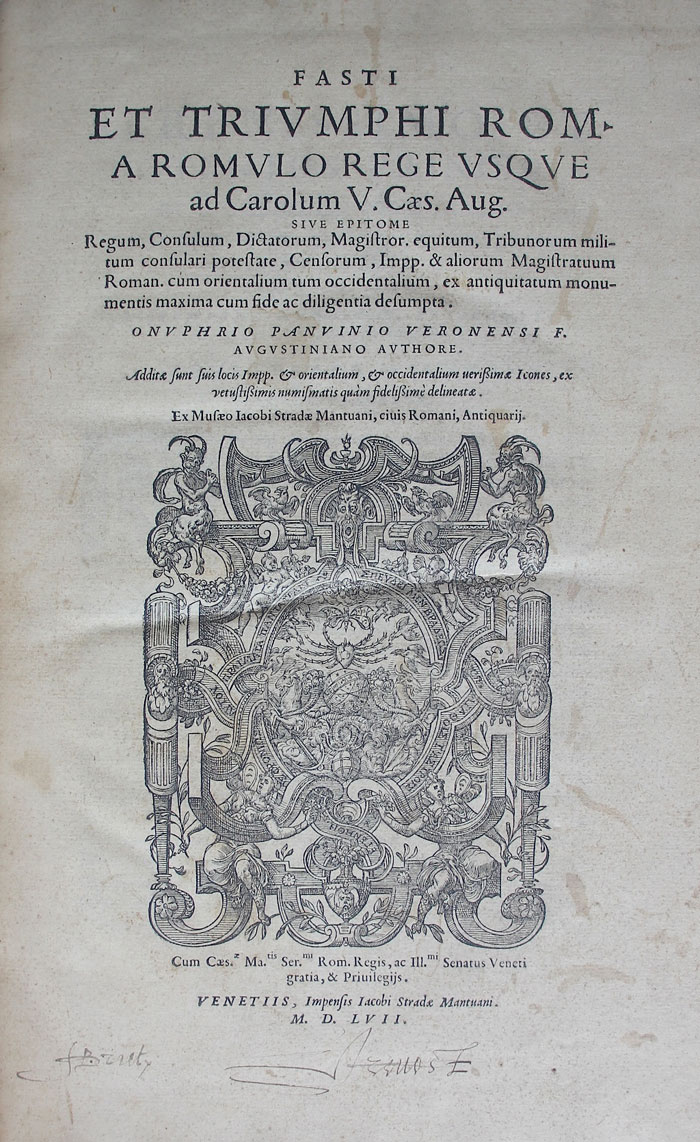
Onofrio Panvinio, Fasti et triumphi Rom. a Romulo rege usque ad Carolum V. Caes. Aug. … Onuphrio Panvinio … authore. … Cum. … Rom. Regis, ac … Senatus Veneti gratia, & priuilegijs (Venice, 1557), title page.
A second factor was the increased supply of ancient coins and medals in the sixteenth century as opposed to the fifteenth century. True, the fifteenth century had witnessed some systematic collecting by a number of Italian princes but nothing on the scale of the sixteenth century.[3] Supply was crucial and Furlotti has drawn attention to the role played not only by antiquarians in building up the collections of their patrons (and, also, their own collections), but also to other players in the numismatic marketplace of early modern Europe.[4] Stefano Degli Alli, writing to Francesco I (1541–87), Grand Duke of Tuscany, drew attention to one of the challenges posed by one element of the numismatic marketplace when he described the numismatic cartels he had to contend with in his search for coins and medals for Francesco I’s burgeoning collection: ‘I have been searching for some medallions or some other things worthy of your highness, but there are some people that deal with these medals and other antiquities that have mutual agreements, so that it is difficult to get anything, unless from their hands, and they operate together with rummagers (‘frugatori’). This is how I call those who spend their day in the squares in order to buy from the peasants that find these things’.[5] As Orsini’s inventory of collections demonstrates, the numismatic marketplace was a crowded one for it included not only royal and aristocratic collectors; antiquarian agents working for them such as Strada and Orsini himself; cartels such as described by Degli Alli; artisans (especially goldsmiths); and peasants who arrived in the city, eager to sell what they had found.[6]
Professional antiquarians such as Orsini, Onufrio Panvinio (1529–68) or Strada, played a crucial role in determining value and developing aristocratic collections. Their knowledge aided aristocratic collectors understand their own collections for antiquarians could explain the often complicated monetary systems involved, and wade through the copious epigraphic evidence to create a coherent history from the material remains.[7] While their focus might have been on their patron’s collections, they also often build up collections of their own. As the title page of Worth’s copy of Panvinio’s Fasti et triumphi Rom. a Romulo rege usque ad Carolum V. Caes. Aug. … Onuphrio Panvinio … authore. … Cum. … Rom. Regis, ac … Senatus Veneti gratia, & priuilegijs (Venice, 1557) demonstrates, he was using the collection of one of the most notable antiquarian agents in early modern Europe, Jacopo Strada.
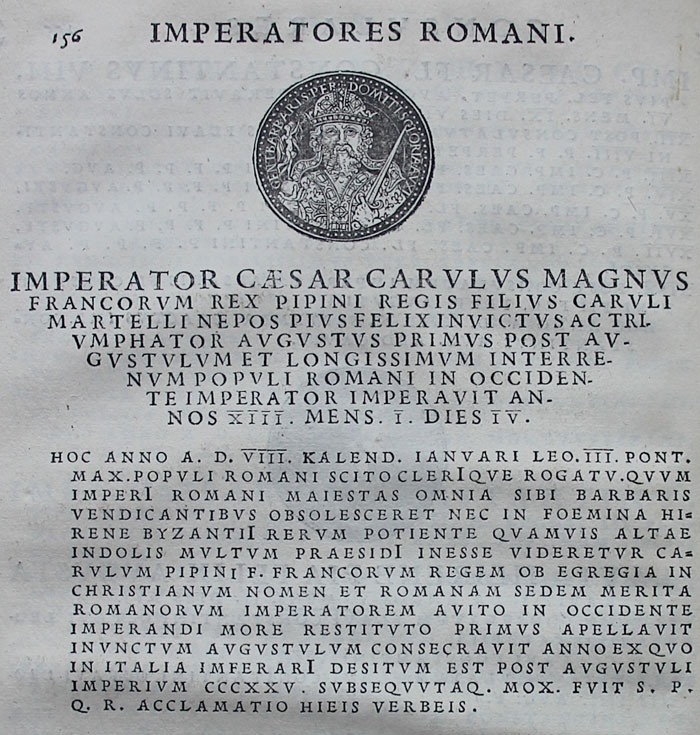
Onofrio Panvinio, Fasti et triumphi Rom. a Romulo rege usque ad Carolum V. Caes. Aug. … Onuphrio Panvinio … authore. … Cum. … Rom. Regis, ac … Senatus Veneti gratia, & priuilegijs (Venice, 1557), p. 156, detail: Charlemagne (742/8–814), Emperor.
A third factor in the sixteenth-century rise of numismatic collecting was the development of coin collections, and in particular contemporary medals, as instruments of state propaganda.[8] This aspect of numismatic collections would continue into the seventeenth and eighteenth centuries. The connections between collecting ancient coins and contemporary medals and the promulgation of political power were always to the fore. Panvinio (and many other antiquarians) did not end his numismatic story with the emperors of ancient Rome, but, as this image demonstrates, continued the story of imperial power to Charlemagne, Emperor (742/8–814), and, to the new Charles, Charles V (1500–58), Holy Roman Emperor.
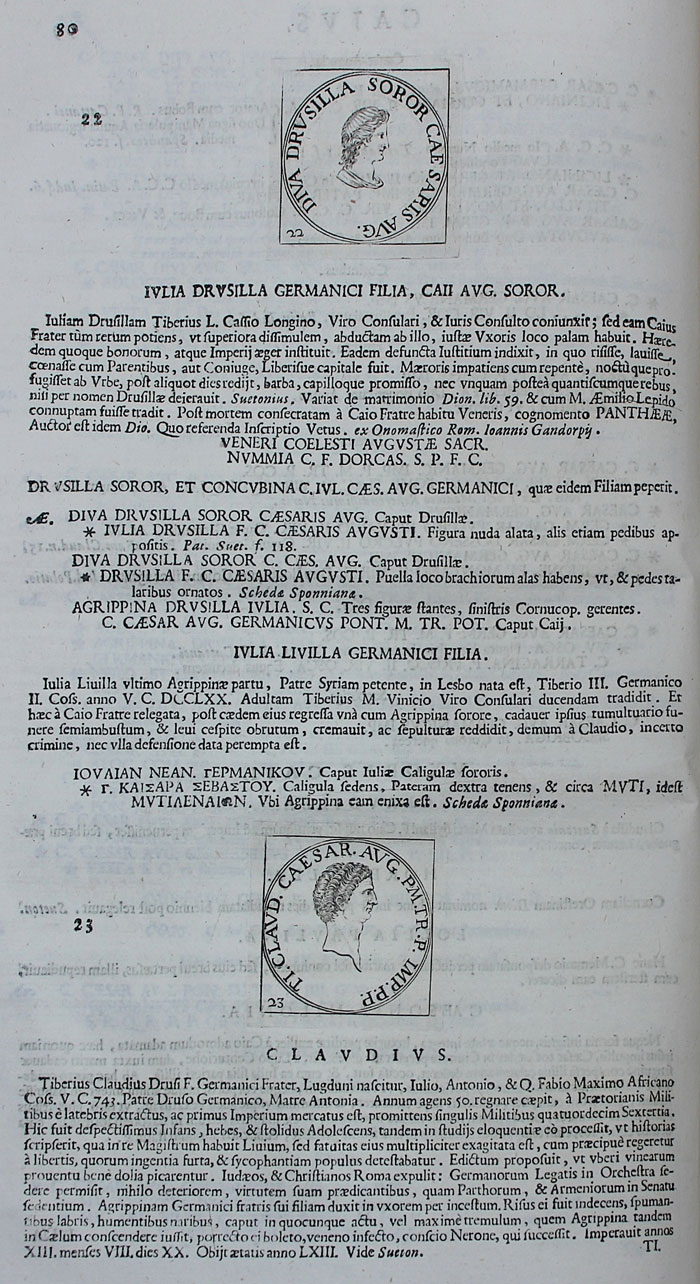
Adolf Occo, Imperatorum Romanorum numismata a Pompeo Magno ad Heraclium ab Adolfo Occone olim congesta, nunc augustorum iconibus, perpetuis historico–chronologicis notis, pluribusque additamentis illustrata, & aucta. … Studio, et cura Francisci Mediobarbi Biragi … (Milan, 1683), p. 80: Julia Drusilla (16–38 A.D.) and Claudius (10 B.C.–54 A.D.), Emperor of Rome.
A fourth factor which stimulated the rise of numismatic publishing was, as Stahl notes, the fact that ‘Coins lent themselves well to the newly developed technology of printing’.[9] Germany, the home of the new printing technology in the fifteenth century, produced a number of leading numismatists in the early modern period and perhaps first among them was Adolf Occo (1524–1606), a Augsburg physician with strong links to Italy, who continued the focus on Roman emperors and empresses. His work Impp. Romanorum numismata a Pompeio Magno ad Heraclium: quibus insuper additae sunt inscriptiones quaedam veteres, arcus triumphales, & alia ad hanc rem necessaria. Summ diligentia & magno labore collecta ab Adolpho Occone R. P. Aug. Medico, antiquiatatum studioso (Antwerp, 1579), was printed by the Plantin press: Worth acquired the later 1683 edition with additional notes by an Italian numismatist, Francesco Mezzabarba Birago (1645–97).
As the title suggests, Occo started with Pompey the Great (106–48 B.C.), and ended in the seventh century with Heraclius (approximately 575–641), Emperor of the East. He chose to provide descriptions, rather than illustrations, and continued this treatment in the second edition of 1601.[10] Worth’s 1683 edition is illustrated, though the images are of a rather poor quality. Occo’s choice not to include images may have been an economic one, since woodcuts added substantially to the cost of numismatic books but Cunnally notes that the chronologically ordered coins are concisely described, allowing Occo to provide more information about coins than in the illustrated editions of his colleagues, so it may have been a stylistic choice.[11] Babelon notes that Occo himself had a large collection but also had access to the extensive numismatic collections of the Fugger banking family.[12]
The French numismatist, Louis Jobert (1637–1719), noted Occo’s first and second editions (commenting that Occo had issued the second edition because he had acquired more coins). Jobert’s views on the third edition of 1683 were, however, less positive:
The Count Mezza Barba de Birague, a Gentleman of Pavia, has put out a Third Edition, wherein he has added several thousands: We should have been very happy, had he seen and described the Medals themselves, and not been obliged to trust to Catalogues and Descriptions that were sent him, and are not often very faithful.[13]
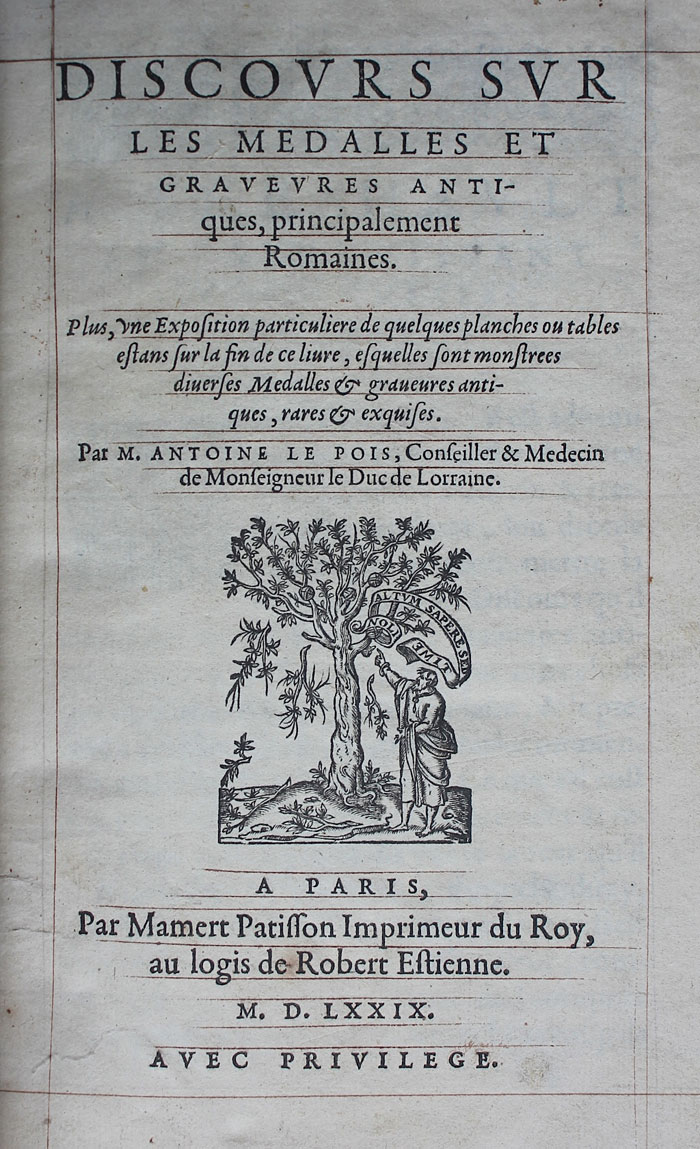
Antoine Le Pois, Discours sur les medalles et graueures antiques, principalement Romaines (Paris, 1579), title page.
Occo’s text had first appeared in print in 1579, the same year as Antoine Le Pois’s Discours sur les medalles et graueures antiques, principalement Romaines (Paris, 1579), which Worth also acquired. The two commentators had professional interests in common for Le Pois (1525–78), was, like Occo, a physician – in his case to Charles III (1543–1608), Duc de Lorraine. There the similarity ended for Le Pois’s Discours sur les medalles et graueures antiques, principalement Romaines (Paris, 1579), is an example of a text which focused not only on the iconography of Roman emperors and empresses, but also widened the scope of his enquiry to include a section on Roman colonies.[14] His text was posthumously printed by Robert II Estienne (1530–88), a member of the influential French printing dynasty whose publications were collected by Worth.
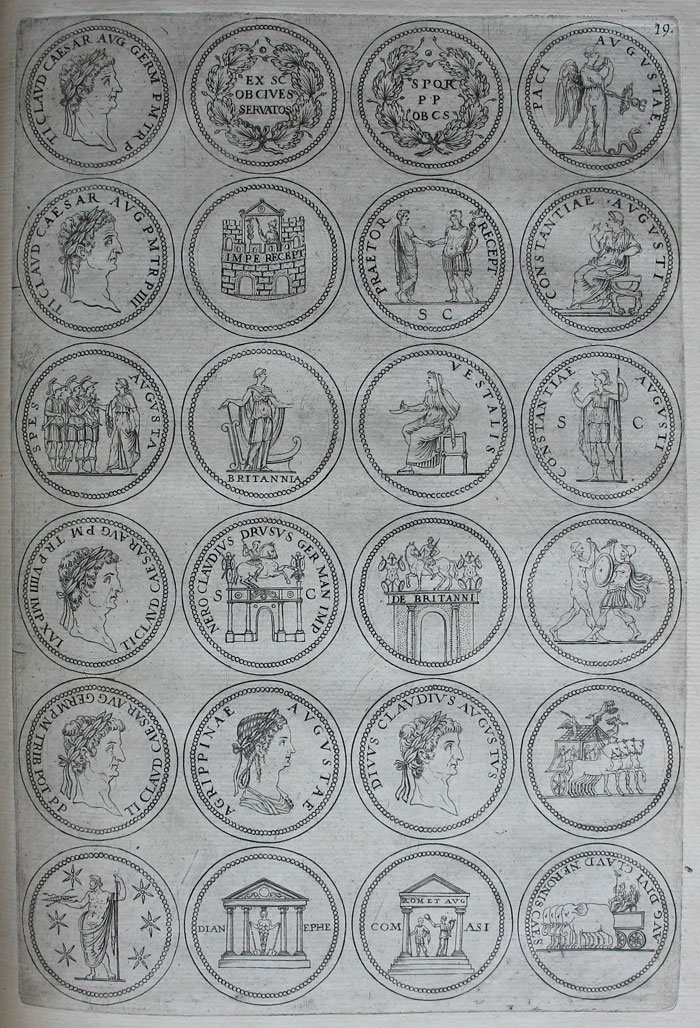
Antonio Agustín, Antiquitatum Romanarum Hispanarumque in nummis veterum dialogi XI. Latinè redditi ab Andrea Schotto … : cuius accessit duodecimus, de prisca religione, diisque gentium. Seorsim editae nomismatum icones a Iacobo Biaeo aeri graphicè incisae (Antwerp, 1617), plate 19: Colonial Roman coins.
Le Pois was not the first to interest himself in the coinage of the Roman colonies: Panvinio had likewise taken an interest in Roman colonies and Roman Spain was the focus of the work of a colleague of Panvinio’s, Antonio Agustín (1517–86), a Spanish Renaissance scholar who was also a friend of Fulvio Orsini (1529–1600).[15] Agustín was a legal scholar who had been educated at the universities of Alcalá and Salamanca, before travelling to continue his education in Italy. There he served as part of the Papal Tribunal and was sent on a number of international missions, before being appointed to various bishoprics: Alifa, Lérida and, finally, Tarragona in 1576, ten years before his death. Worth not only owned his seminal work on coins of Spain under the Roman Republic but also Fragmenta historicorum collecta ab Antonio Augustino, emendata à Fuluio Vrsino : Fului Ursini notae ad Sallustium, Caesarem, Liuium, Velleium, ad Tacitum, Suetonium, Spartianum, & alios (Antwerp, 1595). This post-dated Agustín’s death and had been compiled by his friend Orsini, with whom he had shared news of numismatic finds, and it continued Agustín’s work well into imperial Rome. The tight bond between Orsini and Agustín is likewise visible in Orsini’s dedication of his 1577 work on the coins of republican Rome (also collected by Worth), Familiae Romanae quae reperiuntur in antiquis numismatibus ab urbe condita ad tempora divi Augusti ex bibliotheca Fulvi Vrsini Adiunctis familiis XXX ex libro Antoni Augustini (Rome, 1577), to his patron Cardinal Alessandro Farnese (1520–89), wherein Orsini commented on the debt he owed Agustín.[16]
Agustín’s work on Roman Spain was seminal for a number of reasons. As Acciarino argues, it proved to be the most important work on coinage in colonial Spain.[17] Agustín was important not just because he extended numismatic research in ancient Rome to one of its most important colonies, but also because he sought to help his readers understand the importance of numismatic evidence, by drawing attention to what coins and medals might tell readers about the history and architecture of Rome (and Roman Spain). He also, crucially, provided information on how to recognise genuine ancient coins.[18] More specifically, as Acciarino notes, Agustín drew attention to key characteristics of colonial coinage, especially the presence of a pair of oxen pulling a plough, outlining the boundaries of new cities.[19] To this was added another characteristic: the use of the abbreviations ‘COL’ or simply ‘C’ to indicate colonial status.[20] Augustin is said to have owned 130 gold coins, 1,400 silver coins and 3,871 in bronze, a large and important collection by any standard. Unfortunately his valuable collection is no longer extant for though he left it to the Spanish crown it was subsequently pillaged by the troops of Napoleon I (1769–1821), Emperor of the French.[21]
Many of the above texts are available online on the website of Kunsthistoriches Institute in Florence thanks to their project ‘Translatio Nummorum The Perception of Classical Antiquity via Ancient Coins by Antiquaries in the Renaissance’.
Text: Dr Elizabethanne Boran, Librarian of the Edward Worth Library, Dublin.
Sources
Acciarino, Damiano, ‘Ancient Roman Colonial Coins in Renaissance Europe’, American Journal of Numismatics, 28 (2016), 231–57.
Appleton, W. S., ‘Early Writers on Numismatics’, American Journal of Numismatics, and Bulletin of the American Numismatic and Archaeological Society, 13, no. 1 (1878), 12–5.
Babelon, Ernest, Ancient Numismatics and its History, translated by Elizabeth Saville (London, 2004).
Cunnally, John, Images of the Illustrious: The Numismatic Presence in the Renaissance (Princeton, 1999).
Dwyer, Eugene, ‘André Thevet and Fulvio Orsini: The Beginnings of the Modern Tradition of Classical Portrait Iconography in France’, The Art Bulletin, 75, no. 3 (1993), 467–80.
Furlotti, Barbara, ‘Connecting people, connecting places: antiquarians as mediators in sixteenth-century Rome’, Urban History, 37, no. 3 (2010), 386–98.
Heenes, Volker, ‘[Die Combinations of] Unrelated Obverses and Reverse of Ancient Coins in Jacopo Strada’s Numismatic Works’, Online Zeitschrift zur Antiken Numismatik, 3 (2021), 55–76.
Holt, Frank K., When Money Talks: A History of Coins and Numismatics (Oxford, 2021).
Jobert, Louis, The knowledge of medals, or, Instructions for those who apply themselves to the study of medals both ancient and modern from the French (London, 1697).
Pollard, J. Graham, ‘The Italian Renaissance Medal: Collecting and Connoisseurship’, Studies in the History of Art, 21, Symposium Papers VIII (1987), 161–9.
Simane, Jan, Ulrike Eydinger, and Lisa Hanstein, ‘Translatio Nummorum The Perception of Classical Antiquity via Ancient Coins by Antiquaries in the Renaissance’, Kunsthistorisches Institut in Florenz – Max-Planck-Institut [accessed 24 July 2026].
Stahl, Alan M., ‘Numismatics in the Renaissance’, The Princeton University Library Chronicle, 69, no. 2 (2008), 217–40.
Weiss, Roberto, ‘The Study of Ancient Numismatics during the Renaissance (1313–1517), The Numismatic Chronicle, Seventh Series, 8 (1968), 177–87.
Wickersham Crawford, J. P., ‘Inedited letters of Fulvio Orsini to Antonio Agustín’, PMLA, 28, no. 4 (1913), 577–93.
__
[1] Quoted in Cunnally, John, Images of the Illustrious: The Numismatic Presence in the Renaissance (Princeton, 1999), p. 46.
[2] Holt, Frank K., When Money Talks: A History of Coins and Numismatics (Oxford, 2021), p. 82.
[3] Stahl, Alan M., ‘Numismatics in the Renaissance’, The Princeton University Library Chronicle, 69, no. 2 (2008), 218. Weiss notes that the first signs of interest in numismatics may be dated to the fourteenth century: Weiss, Roberto, ‘The Study of Ancient Numismatics during the Renaissance (1313–1517), The Numismatic Chronicle, Seventh Series, 8 (1968), 177–9.
[4] Furlotti, Barbara, ‘Connecting people, connecting places: antiquarians as mediators in sixteenth-century Rome’, Urban History, 37, no. 3 (2010), 386–98.
[5] Ibid., 387.
[6] Ibid., 388.
[7] Stahl, ‘Numismatics in the Renaissance’, 218. As Stahl notes, the appearance of the De asse et partibus eius (Paris, 1514), which Worth owned in 1556 Basle edition, was important in addressing such monetary issues.
[8] Pollard, J. Graham, ‘The Italian Renaissance Medal: Collecting and Connoisseurship’, Studies in the History of Art, 21, Symposium Papers VIII (1987), 162. Pollard (p. 163), notes that the largest surviving collection of Italian Renaissance medals is that collected by the Medici family – it is now housed in the Museo Nazionale del Bargello at Florence.
[9] Stahl, ‘Numismatics in the Renaissance’, 217.
[10] Cunnally, Images of the Illustrious, p. 203.
[11] Ibid., p. 131.
[12] Babelon, Ernest, Ancient Numismatics and its History, translated by Elizabeth Saville (London, 2004), pp 78–9.
[13] Jobert, Louis, The knowledge of medals, or, Instructions for those who apply themselves to the study of medals both ancient and modern from the French (London, 1697), p. 45.
[14] Acciarino, Damiano, ‘Ancient Roman Colonial Coins in Renaissance Europe’, American Journal of Numismatics, 28 (2016), 240.
[15] Ibid., 235.
[16] Wickersham Crawford, J. P., ‘Inedited letters of Fulvio Orsini to Antonio Agustín’, PMLA, 28, no. 4 (1913), 580.
[17] Acciarino, ‘Ancient Roman Colonial Coins in Renaissance Europe’, 246.
[18] Stahl, ‘Numismatics in the Renaissance’, 226.
[19] Acciarino, ‘Ancient Roman Colonial Coins in Renaissance Europe’, 236.
[20] Ibid., 250.
[21] Heenes, Volker, ‘[Die Combinations of] Unrelated Obverses and Reverse of Ancient Coins in Jacopo Strada’s Numismatic Works’, Online Zeitschrift zur Antiken Numismatik, 3 (2021), 71.