Lorenz Beger in Heidelberg and Brandenburg
The career of Lorenz Beger (1653–1705), a German librarian who became a numismatist in response to the demands of his patron in Heidelberg, demonstrates the almost symbiotic link between sixteenth- and seventeenth-century writers on numismatics and early modern courts. As Sara Smart has noted, Beger’s interest in numismatics was fuelled by his interactions with four rulers in early modern Germany: two electors of the Palatinate and two electors of Brandenburg: Karl Ludwig I (1617–80), Elector Palatine and his son Karl Ludwig II (1651–85), their cousin Friedrich Wilhelm (1620–88), Elector of Brandenburg, and his son Frederick III (1657–1713), Elector of Brandenburg who subsequently became Frederick I, King of Prussia from 1701 onwards.[1]
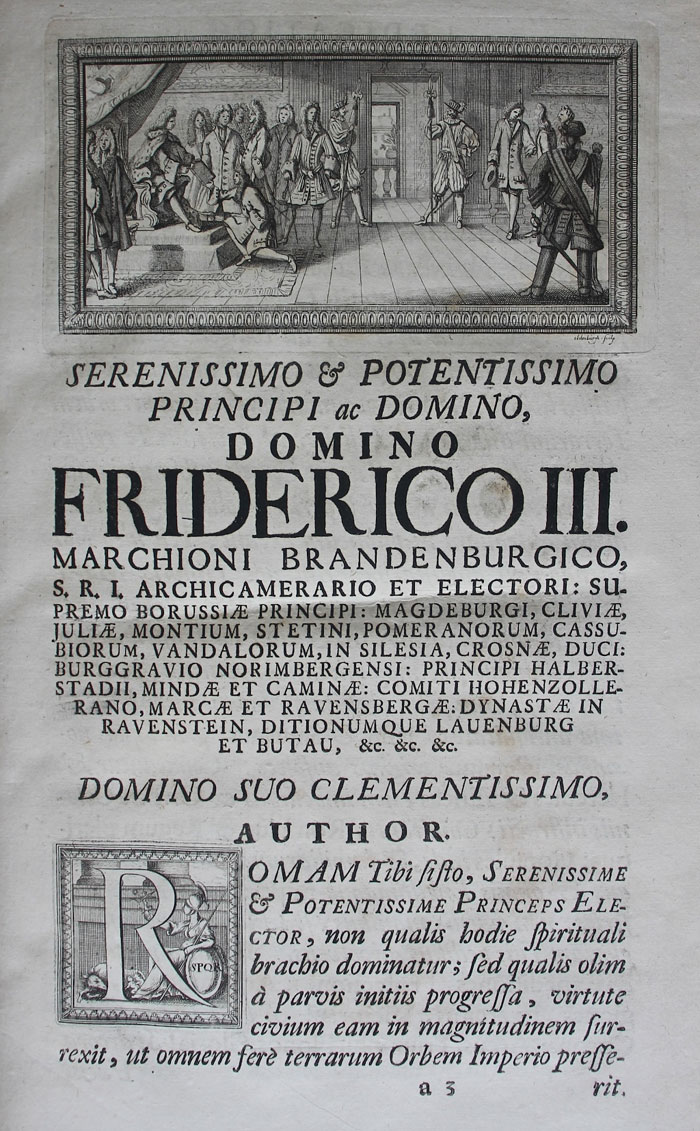
Lorenz Beger, Thesauri Electoralis Brandenburgici continuatio: sive Numismatum Romanorum, quae in cimeliarchio Electorali Brandenburgico asservantur, tam consularium quam imperatoriorum, series selecta, aere expressa, et commentario illustrata, authore Laurentio Begero (Cologne, Berlin and Leipzig, 1698), Sig. a3r: Dedication to Frederick III (1657–1713), Elector of Brandenburg, later Frederick I, King of Prussia.
In the above image we see Beger solemnly presenting his book to Frederick III, still Elector of Brandenburg, as the book was printed three years before his coronation in 1701. In reality, however, the guiding light behind the foundation of the collection was Karl Ludwig I, Elector of the Palatinate, and father of Elisabeth-Charlotte (Liselotte) of the Palatinate (1652–1722), Duchesse D’Orléans, the second wife of Monsieur (Phillipe I, Duc D’Orléans (1640–1701), the only brother of Louis XIV (1638–1715)). The family connection did the Palatinate little good, for Louis XIV laid waste to Heidelberg during the Nine Years War (1688–97).
Karl Ludwig I had appointed Beger as his librarian in 1675 and it was Karl Ludwig I who decided that the library should, amongst its antiquarian treasures, include a numismatic collection. As Smart notes, there were many reasons why Karl Ludwig I (and his daughter Liselotte) were interested in coins: for some they were a tangible link to the past, for others they might promote virtuous behaviour, given that many included references to virtues.[2] But for Karl Ludwig I, his numismatic collection was not solely a status symbol – he was interested in the subject and adept enough to teach his fledgling librarian.[3] By 1685 Beger was able to produce a book on the numismatics treasures of the Palatinate – Thesaurus ex thesauro Palatino selectus; sive Gemmae & Numismata Cimeliarchi Elect. Patatini elegantiori aeri incisa & commentario illustrata (Heidelberg, 1685).[4] By this time Karl Ludwig I was dead and his son was not long to survive him, dying in the same year as Beger’s publication. The Palatinate coin collection was inherited by Karl Ludwig II’s first cousin once removed, Friedrich Wilhelm (1620–88), Elector of Brandenburg, and thus became subsumed into the Brandenburg cabinet of curiosities.
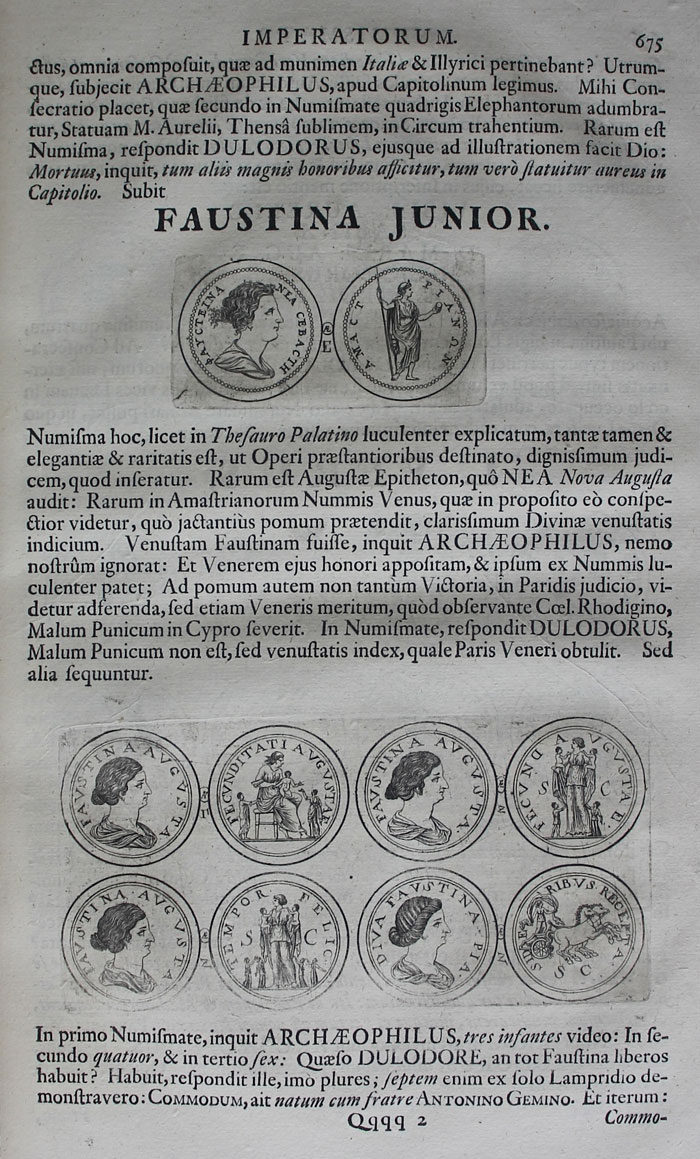
Lorenz Beger, Thesauri Electoralis Brandenburgici continuatio: sive Numismatum Romanorum, quae in cimeliarchio Electorali Brandenburgico asservantur, tam consularium quam imperatoriorum, series selecta, aere expressa, et commentario illustrata, authore Laurentio Begero (Cologne, Berlin and Leipzig, 1698), p. 675: coin depicting Faustina Junior (Annia Galeria Faustina the Younger, d. 175), Empress consort of, wife of Marcus Aurelius (121–80), Emperor of Rome.
This coin, depicting Faustina Junior, the wife of Marcus Aurelius, was part of the Palatinate collection, and Beger had included a description of it in his 1685 work. Beger considered it very rare. The lower coins focus on Faustina Junior’s role as a mother, with first three, then four, then finally six children being depicted. In reality Faustina Junior gave birth to at least fourteen children, including Marcus Aurelius’s notorious successor Commodus (161–92), Emperor of Rome.
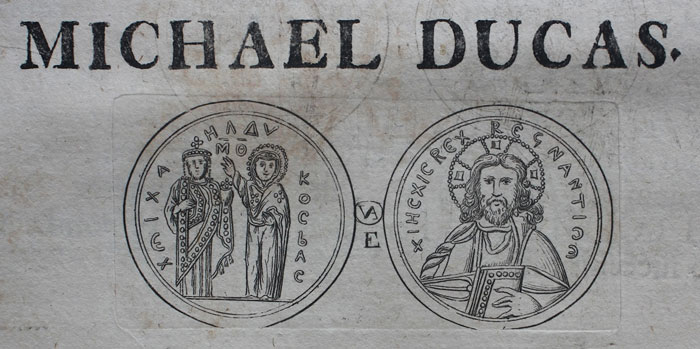
Lorenz Beger, Thesauri Electoralis Brandenburgici continuatio: sive Numismatum Romanorum, quae in cimeliarchio Electorali Brandenburgico asservantur, tam consularium quam imperatoriorum, series selecta, aere expressa, et commentario illustrata, authore Laurentio Begero (Cologne, Berlin and Leipzig, 1698), p. 865, detail: coin depicting Byzantine Emperor Michael VII Ducas (1059–78), Emperor of the East.
While Beger had had to navigate some choppy political currents when his primary patron, Karl Ludwig I, died in 1680, he was lucky that Friedrich Wilhelm was also interested in numismatics and had already amassed a sizeable collection of coins.[5] Schimmel accredits the Great Elector with the foundation of the Brandenburg-Prussian medal collection.[6] The acquisition of the Palatinate hoard doubled the Brandenburg numismatic collection at one stroke and, as Schimmel notes, by the end of his reign Friedrich Wilhelm had amassed over 20,000 items.[7] Beger’s 1685 book had made him famous as a numismatist and the electors of Brandenburg, father and son, made sure that they retained his services as director of their Kunstkämmerer, for Frederick III likewise proved to be interested in the collection.[8] Beger became a fellow of the new Prussian Academy established by Frederick III and authored a number of works on numismatics, all collected by Worth: Spicilegium antiquitatis sive Variarum ex antiquitate elegantiarum vel novis luminibus illustratarum vel recens etiam editarum fasciculi, exhibente L. Begero … (Cologne, 1692); Meleagrides et Aetolia, ex numismate Kyrieon apud Goltzium: interspersis marmoribus quibusdam, de Meleagri interitu, & Apri Calydonii venatione: in lucem vindicatae à Laurentio Begero … (Cologne, 1696); Cranae insula Laconica, eadem & Helena dicta, & Minyarum posteris habitata: ex numismatibus Goltzianis, contra communem opinionem, quae ad Helenam Atticae respexit … (Cologne, 1696); Bellum et excidium Trojanum, ex antiquitatum reliquiis, tabula praesertim, quam Raphael Fabrettus edidit, Iliaca delineatum, & adjecto in calce commentario illustratum à Laurentio Begero … (Berlin and Leipzig, 1699); and Numismatum modernorum cimeliarchii Regio-Electoralis Brandenburgici sectio prima, continens numismata pontificum Romanorum, aliorumque ecclesiasticorum, rariora & elegantiora: aere expressa & dialogo illustrata à Laurentio Begero … (Cologne, 1704).
Worth did not acquire all of Beger’s publications but crucially he added this 1698 volume (Thesauri Electoralis Brandenburgici continuatio: sive Numismatum Romanorum, quae in cimeliarchio Electorali Brandenburgico asservantur, tam consularium quam imperatoriorum, series selecta, aere expressa, et commentario illustrata, authore Laurentio Begero (Cologne, Berlin and Leipzig, 1698)), to his collection. It is volume II of a three-volume set (volume I appeared in 1696 and volume 3 in 1701). The volume reflects his studies both at Heidelberg and Brandenburg for it combines information from both the Palatinate and Brandenburg collections, two of the most important coin collections in early modern Germany. In effect, Beger’s publication put the Brandenburg numismatic collection on the map of important antiquarian sites in Europe.[9] The numismatic collections of the electors of Brandenburg now form part of the Münzkabinett at Berlin.
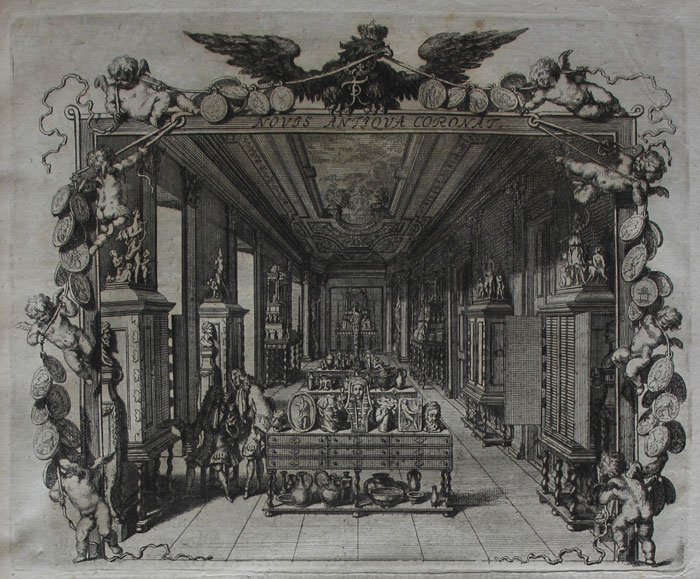
Lorenz Beger, Numismatum modernorum cimeliarchii Regio–Electoralis Brandenburgici sectio prima, continens numismata pontificum Romanorum, aliorumque ecclesiasticorum, rariora & elegantiora: aere expressa & dialogo illustrata à Laurentio Begero (Cologne, 1704), p. 1, detail: Two figures inspecting a cabinet of curiosities.
Text: Dr Elizabethanne Boran, Librarian of the Edward Worth Library, Dublin.
Sources
Hoefer, Ferdinand, Nouvelle Biographie Générale depuis les temps les plus reculés jusqu’à 1850–60 (Copenhagen, 1964), vol. v, p. 154.
Schimmel, Stefan, ‘The Coin and Medal Collection of the Prussian Royal Family 1640 to 1918’, Künker Auctions blog post [accessed 15 July 2026].
Smart, Sara, ‘On the Diverse Duties of the Servants of Princes: Lorenz Beger (1653–1705), Librarian, Antiquarian, and Court Poet in Heidelberg’, The Modern Languages Review, 94, no. 4 (1999), 1025–40.
___
[1] Smart, Sara, ‘On the Diverse Duties of the Servants of Princes: Lorenz Beger (1653–1705), Librarian, Antiquarian, and Court Poet in Heidelberg’, The Modern Languages Review, 94, no. 4 (1999), 1025.
[2] Ibid., 1028.
[3] Ibid.
[4] This text was not collected by Worth.
[5] Smart, ‘On the Diverse Duties of the Servants of Princes’, 1029.
[6] Schimmel, Stefan, ‘The Coin and Medal Collection of the Prussian Royal Family 1640 to 1918’, Künker Auctions blog post [accessed 15 July 2026].
[7] Ibid. and Smart, ‘On the Diverse Duties of the Servants of Princes’, 1029.
[8] Ibid.
[9] Ibid., 1030.