Dekesel – the New Numismatic Standard Reference
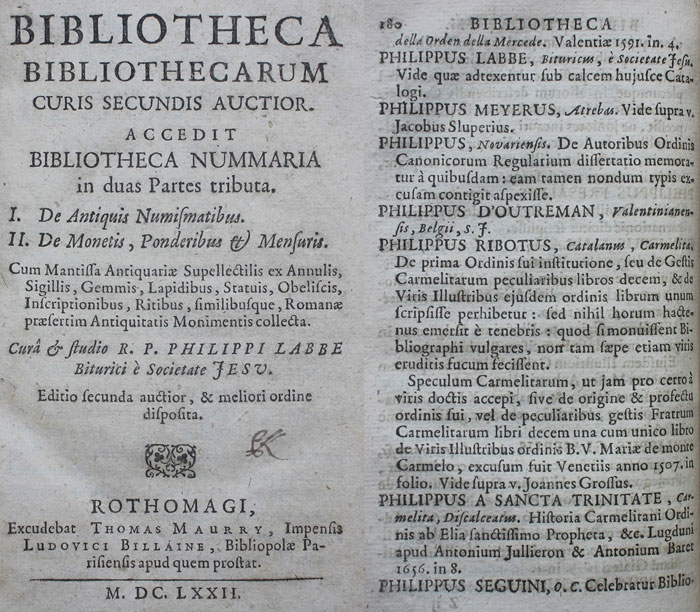
Philipp Labbe, Bibliotheca bibliothecarum curis secundis auctior, accedit Bibliotheca nummaria in duas partes tributa. I. De antiquis numismatibus. II. De monetis, ponderibus & mensuris. Cum Mantissa antiquariae supellectilis ex annulis, … romanae praesertim antiquitatis monimentis collecta / Cura & studio … Philippi Labbe (Rouen, 1672), title page and p. 180. An example of Dekesel Category 5: Numismatic bibliographies and catalogues of libraries with significant numismatic entries.
Numismatic Book Referencing
The Oxford English Dictionary defines ‘numismatics’ as, ‘the study or collection of coins, banknotes, and medals’.[1] The definition is beguiling by its simplicity, perhaps inadequate. It does not lead us to think of the design or fabrication processes by which coins, banknotes, and medals are brought from concept to reality. It does not seem to allow for the subfields of the discipline which include tokens, jetons, counters, communion tokens, and other coin-like objects, variously called ‘paranumismatics’ (UK), or ‘exonumismatics’ (US). It does not suggest to the mind the study of economics. Though it specifies ‘study’, its wording does not lead us to contemplate the collection of books and literature dealing with the discipline and the resulting studies in numismatic bibliography, nor indeed, biography. Dekesel, although referencing the best numismatic dictionary in the English language, still finds Frey’s definition falling somewhat short.[2] He resorts to German writers and their definitions to get as close as possible to working definitions. Thus, numismatics is ‘the science of coins in all their relationships, i.e. as products of the State, as means of circulation, as works of art, as memorials to previous ways of writing and speaking’, or ‘A [sub]discipline within the historical sciences, the subject of which is the coin in all its historical, economic, political, legal, cultural and technical relationships’.[3]
Having defined the discipline, we then move to consider the reference works, or helps and aids, that we use in our study of the field. Dr Worth guides us into our study, for as we have noted elsewhere, he had an interest in numismatic reference works. On his shelf was Philippe Labbe’s, Bibliotheca Bibliothecarum (Rouen, 1672), a catalogue of library collections, in a fine gold-tooled binding.[4] This volume included Labbe’s, Bibliotheca Nummaria (Rouen, 1672), the earliest in a line of numismatic bibliographies still in use in the twenty-first century.[5] Worth had a second copy of this in an anthology of key numismatic texts.[6] Ever one to keep up to date with the latest research, he purchased Anselmo Maria Banduri’s Bibliotheca Nummaria (Hamburg, 1719) at some point in his maturer years.[7] These works were designed to be comprehensive and universal numismatic bibliographies. Long after Worth’s passing, J. G. Lipsius’, Bibliotheca Numaria (Leipzig, 1801), followed in this stream of endeavour, though as the publisher John Drury stated, Lipsius’ work was not ‘outstanding either for its bibliographical scholarship or indeed for its accuracy’.[8] Nonetheless, since no one had superseded Lipsius’ ‘comprehensive and universal’ treatment of numismatics, Drury republished it unaltered in a facsimile edition as late as 1977.
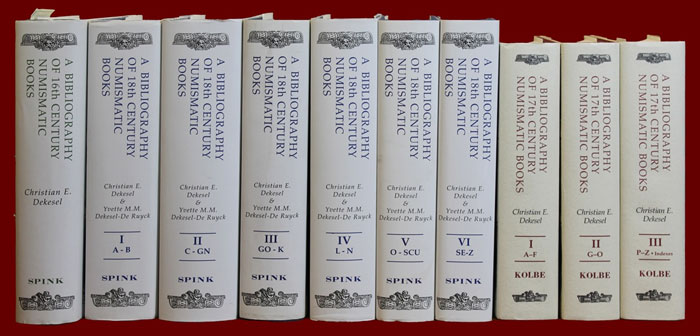
Image of Dekesel’s Bibliotheca Nummaria complete ten-volume set.
Christian E. Dekesel FSA (Fellow of the Society of Antiquaries of London), after a lifetime in numismatic bibliography, says of these earlier works, ‘The bibliographical deficiency of all of them amounts to at least 30% of their entries which makes them more or less worthless for modern bibliographical research’.[9] This led Dekesel to attempt a completely new work, one which set out to break the cycle of copied errors in the chain of numismatic bibliographical works over the centuries. He first published a single volume on the sixteenth century, followed by three volumes for the seventeenth century, and six volumes for the eighteenth century. The available literature was vast. Dekesel excluded from his endeavours periodicals, anonymous publications and official State publications. These were not irrelevant; he needed to be pragmatic in what he could achieve, whilst leaving a template that others could build upon.[10] It is Dekesel’s monumental bibliography that I have used as the baseline for studying the numismatic literature in the Edward Worth Library.[11]
What Constitutes Numismatic Literature?
Christian E. Dekesel, Bibliotheca Nummaria : bibliography of 16th century numismatic books ; illustrated and annotated catalogue (London and Crestline, Calif., 1997).
The fundamental question for compiling a bibliography of such material within the Worth Library was, what constitutes numismatic literature. Most modern readers coming to this subject are likely to question or at least wonder why certain titles within the Library have made the list (see Worth as a Collector), or why the standard reference works include them. However, it is unlikely that Dr Worth would dispute the extent of the list.[12] It is a subject to which Dekesel has applied scientific methodology, a methodology founded on the ‘Axiom of Informational Relevance’ (Information Retrieval).[13] Dekesel was careful not to be driven by idiosyncratic principles which would reduce him to ‘some alienated researcher … doing something in which nobody is interested!’[14] For this reason, he analysed ‘all existing numismatic bibliographies … and accepted as a general rule, that all references they contained were of a numismatic nature. In so doing we [he says] established the authority of the ‘elders’’.[15] I, too, have followed this same principle of resting on the ‘authority of the elders’ in my study of Edward Worth’s numismatic material. In what follows, I aim to draw together various strands to form the thread of rationale for including a work in the body of numismatically relevant literature to be found in Dr Worth’s library. It will be illustrative rather than exhaustive.
Reassessing Classifications

Dekesel Categories summarized.
In seeking to wrangle the vast body of numismatic literature into manageable proportions, Dekesel provides us with, in Burnett’s words, a ‘novel ‘taxonomy’’.[16] If one considers the ‘categories’ into which Worth’s numismatic literature falls (see table above), it will quickly become evident that, by our usual standards, there is a large body of literature included that is not exclusively numismatic in nature.[17] Rather than excluding it, perhaps a re-evaluation of our current thinking is needed. We may have been misleading ourselves by the modern predilection to compartmentalise into subjects, trying to get each topic as watertight as we can make it. In an age of increasing specialisation in academia, there is already a discussion taking place in how we relate various disciplines as we look back at previous academic work. Contributors to The Alchemy of Medicine and Print : the Edward Worth Library, Dublin (Dublin, 2010), drew attention to this: as Westerhof noted in her introduction to the volume, Ibnou-Zahir suggested we should ‘reassess our own notions about the relationship between medicine and philosophy [in its broadest sense]’; Caygill argued that ‘modern scholarship … has underestimated the extent to which [Descartes] subscribed to the integration of medicine and (natural) philosophy’; Koźluk proposed that we should situate the contents of a work on syphilis in Worth’s library ‘within the wider context of medical and intellectual enquiry’; and Westerhof sought to elucidate how a work considered to be an agricultural work ‘was much more than a work on agriculture … [and] should be read from a traditional natural philosophical and medical perspective which centralized the maintenance and restoration of health’.[18]
Without doubt, ‘Numismatics, the study of coins, has developed a distinct disciplinary identity from as early as the eighteenth century’.[19] However, the world that Dr Worth inhabited was bounded by a different philosophy than our own – it had a unified view of nature – and by consequence, the books produced necessarily touched on a broad range of topics with a view to uniting into one seemingly disparate strands.[20] As Martin has said, ‘It is ironic that the world that (the great alchemist) Newton helped create has anything but a unified view of nature … ’.[21] Dekesel, whose monumental bibliography includes many of these works we would ordinarily exclude, states that ‘Numismatics is not a science which is studied in an isolated area. From the start the study of numismatics was always incorporated in a wider framework of culture, trade, art and history’.[22]
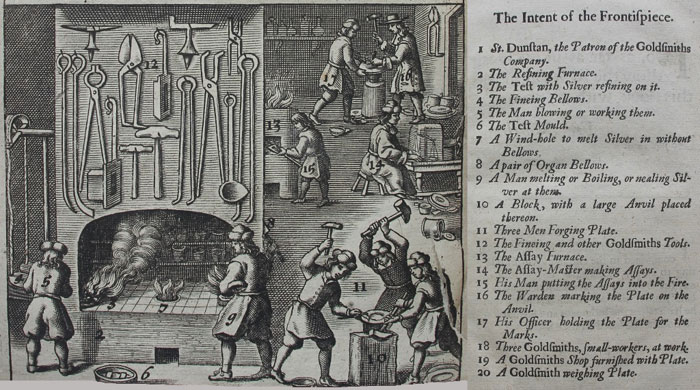
W.B. [William Badcock], A new touch-stone for gold and silver wares … (London, 1679), frontispiece incorrectly placed facing p. 125, detail and key to the frontispiece. This is an example of Dekesel Category 2: Monetary history, theory, economics, political context, legal consequences, and economic context of coins and coinage; metallurgy & alchemy.
As a practical example of the above, after having mentioned Sir Isaac Newton (1642–1727), it may be instructive to consider why the topic of ‘alchemy’ would find a place in numismatic literature. Alchemy features in Dr Worth’s collection and is certain to have found there a place for itself by virtue of the medical quest for an elixir of life. Many of those authors, such as Newton and Robert Boyle (1627–91), that Worth sought out were more than interested in the topic. The subject was also of numismatic fascination insofar as alchemy concerned the possibility of transmutation of base metals into precious metals. Given Worth’s evident interest in various branches of numismatics, alchemy was bound to be of interest from this perspective too.[23] In fact, it is said that ‘by the early 1730s ‘alchimia’ has in some circles been reduced to the study of the transmutation of metals alone’.[24] Whilst much alchemic endeavour was futile, and many fortunes lost, many interesting and useful results emerged during the course of its study and experimentation. More generally, ‘Alhazen invented the camera obscura. Alcoholic distillation, phosphorus, porcelain and sodium nitrate were all the products of the alchemist’s lab’.[25] Herman Boerhaave (1668–1738), in his not uncritical editing of Geber’s Lapis Philosophorum (The Philosopher’s Stone), opined that one found there ‘abundance of curious and useful things about the nature of metals, their purification, fusion, malleability, &c.’.[26] Dekesel’s inclusion of alchemy within the rubric of ‘numismatic literature’, and Dr Worth’s interest in alchemy beyond the sphere of medicine, is in line with the thinking of others too: as Boran notes, ‘That the alchemical quest for the transmutation of gold continued into the early eighteenth-century collection of Worth is demonstrated by the inclusion of Jean-Jacques Manget’s Bibliotheca chemica curiosa, seu Rerum ad alchemiam pertinentium thesaurus instructissimus (Cologne, 1702)’.[27]
The arts of portraiture and sculpting were closely linked with numismatics too, with the Monnaie de Paris (the French Mint) ‘giving many great sculptors the chance to realise their designs’ in coins and medals.[28] We have shown reason to include alchemy, portraiture and sculpting in the numismatic record. As to why more general histories should be included, we can hardly do better than to consult the opening chapters of Haskell’s History and its Images : Art and the Interpretation of the Past (New Haven, Conn. and London,1993) for a conclusive reason.[29] The early chapters focus on early numismatists, their coins and medals.[30] ‘Coins, it has well been said, are the living eyewitnesses of historical facts; ‘they not only verify but they also vivify history’’.[31] It was by this means that the historians and artists of the early modern era began to illustrate and shape their works on Greek and Roman history, despite the risks involved. Could it be assumed that the historic figures on the coins and medals had been accurately depicted? Was artistic licence used or were these pieces able to be trusted? Haskell states that ‘[i]t was the very beauty of art that was bound to make it a deceptive, even a treacherous, guide’.[32] Nonetheless, it was the physical coin record that allowed historic personages to be named, dated, pictured, and set in the context and chronology of their times. It was the physical coin record that traced the development of metallurgy and the progression of minting as a skill. It tracked religious emblems and symbolic depictions, including language and inscriptions.[33] For all these reasons and many more, numismatics, or the study of coins and medals, has found a prominent, even foundational, place in the wider field of literature.
Haskell argues that, ‘[T]he care devoted to numismatics in the sixteenth and seventeenth centuries constitutes one of the greatest (but most neglected) achievements of Renaissance scholarship’.[34] Perhaps one of the reasons for this neglect is that numismatic work was being employed chiefly in the service of other topics rather than merely studied intrinsically. Medical, metallurgical, metrological, religious, historical, and artistical works all utilised numismatics for their own purposes.[35] This accounts for numismatic material being scattered throughout a diverse and seemingly unrelated body of literature. It is not that there were no ‘truly numismatic publications’, or ‘specialist numismatic books’, but there was a wide swathe of literature that used numismatics as an ancillary.[36] That literature still continues to be relevant to our field and discipline.
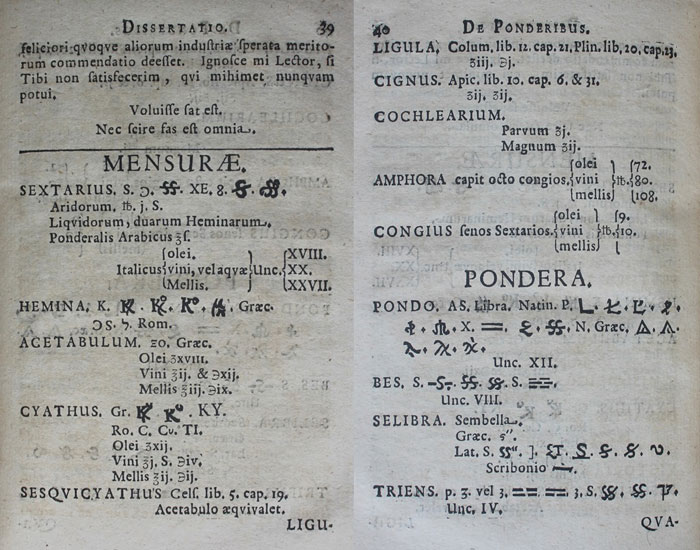
Johan Rode, De acia dissertatio ad Cornelii Celsi mentem qua simul universa fibulae ratio explicatur Secundis Curis ex autographo autoris auctior & emendatior, cum judiciis doctorum edita a Th. Bartholino. Accedit De ponderibus et mensuris ejusdem autoris dissertatio, & Vita Celsi (Copenhagen, 1672), pp 39–40 of De Ponderibus et mensuris veterum medicorum. An example of Dekesel Category 3: Mensuration, weights and measures, their use in coinage, and for other purposes, e.g. medicinal, trade, etc.
Interestingly, in the context of our study of a Dublin physician’s library, ‘the flood of serious [numismatic] studies that continued to flow from the presses in France, Italy the Low Countries soon began to show a certain narrowing in the social background of the scholars responsible for it. It was not long before physicians assumed a dominant role’.[37] Presumably, alchemy (as mentioned) and weights and measures (which features so prominently) were the commonplace of daily life to a practicing physician. Renauldin published biographies and an analysis of the writings of an impressive sixty-one medical doctors who were numismatists.[38] Thirty-eight of these authors were in Dr Worth’s library, represented by least 149 publications. Some of these authors Worth may have known personally, such as John Arbuthnot (bap. 1667, d. 1735), a fellow at the Royal Society. In light of such an affinity of medics with numismatics, Worth’s perceptive purchasing is scarcely conceivable without the intellectual guidance provided within the Republic of Letters (Respublica Literaria) – a transnational, early‑modern community of scholars who exchanged knowledge through extensive correspondence (largely in Latin), forming an informal intellectual network across Europe and further afield.[39]
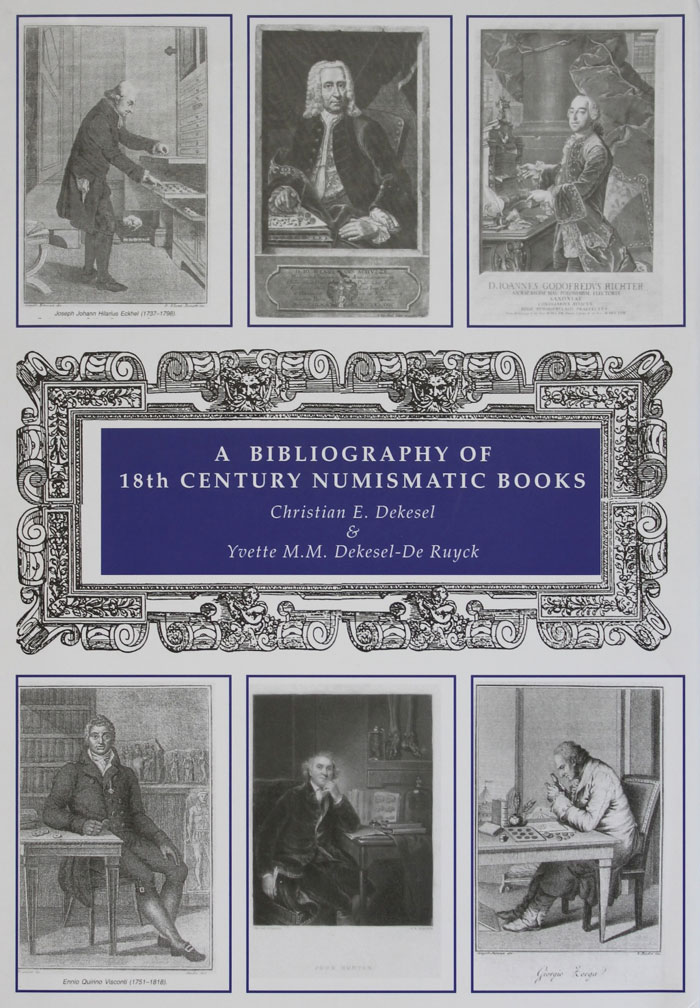
Christian E. Dekesel and Yvette M. M. Dekesel-De Ruyck, Bibliotheca Nummaria III : bibliography of 18th century numismatic books ; illustrated and annotated catalogue, 6 vols (London and Crestline, Calif., 2009–19).
Many numismatic threads and links in the literature Dr Worth was buying and reading are not immediately apparent, but it is unlikely that Worth was ignorant of at least some of them. For example, among Worth’s authors are three generations of the famous Dutch family, Heinsius: Daniel (1580–1655), Nicholas the Elder (1620–81), and Nicholas the Younger (1655–1718). Nicholas the Elder, who had one of the largest private libraries in Europe, profited from his 1647 pérégrination érudite to ‘… procure old coins’, later joining with Isaac Vossius (1618–89), a favoured author of Worth, in supplying coins and medals from his travels to Christina, Queen of Sweden, in 1651.[40] Nicholas the Younger would follow his father in serving Queen Christina (1626–89), this time as physician. Nils Keder (1659–1735), five of whose works appear in Worth’s collection, would go on to catalogue the royal collection that Queen Christina put together, helped by Heinsius the Elder. These connections and interconnections could with profit include Marco Aurelio Severino (1580–1656) and Enea Vico (1523–67), favourites of Worth, and their connections to Naples, a city on which Worth had specific numismatic literature.[41]
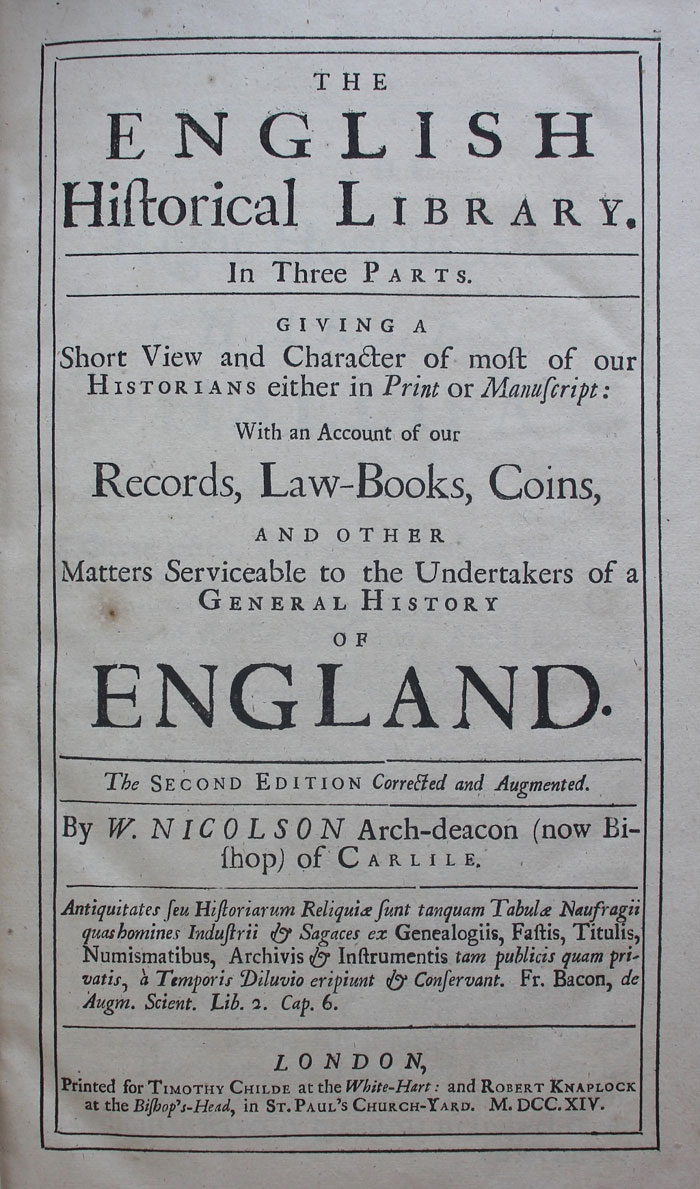
William Nicolson, The English historical library. In three parts. Giving a short view and character of most of our historians either in print or manuscript: with an account of our records, law-books, coins, and other matters serviceable to the undertakers of a general history of England (London, 1714), title page. An example of Dekesel Category 11: General histories with some numismatic content.
Dekesel’s Referencing Simplified
Referencing systems must be simple and transparent so that newcomers to a field can understand and apply them without difficulty. Christian and Yvette Dekesel’s Bibliotheca Nummaria was a long-term undertaking that developed in scope and structure as successive volumes appeared. Inevitably, adjustments were made during the project, and once material is published it cannot be retrospectively harmonised. Now that the enterprise has concluded, and no further volumes or reissues are anticipated, it is possible to examine the whole corpus and rationalise its referencing for present purposes.[42]
I have therefore synthesised Dekesel’s sixteenth-, seventeenth- and eighteenth-century bibliographies in order to establish a clear and consistent referencing method. When the ten-volume Bibliotheca Nummaria is considered as a unified work, four structural difficulties emerge. First, unlike Eimer and Schulman, Dekesel as the bibliographer is not embedded in the reference number, which obscures the identity of the bibliographer.[43] Second, the internal categorisation system changes between the three centuries.[44] Third, the alphabetic referencing used in each century is indistinguishable from that used in the others. Fourth, the eighteenth-century volumes were issued seriatim rather than in a single year, which prevents the year of publication from serving as a chronological marker. Had the six eighteenth-century volumes appeared together, the year of issue could have differentiated the centuries. To resolve these problems, I have adopted a standardised method of distinction (see righthand column below) that is simple, stable and self-explanatory. It has the merit of reducing to a minimum any alteration of Dekesel’s material, facilitates identification across centuries, and highlights that the Dekesels have produced the standard reference work in numismatic bibliography.[45]
| Dekesel’s first entry in each century |
My standardised referencing | |
| 16th century (1 vol.) | A1(cat.3) | Dek.16-A1(cat.3) |
| 17th century (3 vols) | A1 (cat.1) | Dek.17-A1(cat.1) |
| 18th century (6 vols) | A1 (cat.4) | Dek.18-A1(cat.4) |
Thus, at a glance, confusion between the centuries is eliminated.
Dekesel organised the literature by genre. His sixteenth-century volume employed six categories; his seventeenth- and eighteenth-century volumes expanded this to twelve. Categories 5 and 6 in the sixteenth-century work were later combined into Category 11 for the subsequent centuries. When referring to sixteenth-century items originally placed in Categories 5 or 6, I re-designate them as Category 11 in my database and indicate this standardisation by square brackets.[46] Thus A13(cat.5) and A14(cat.6) become Dek.16‑A13[cat.11] and Dek.16‑A14[cat.11]. The example of Juan de Mariana (1535–1624) below illustrates this practice. Where a work is not recorded by Dekesel but clearly belongs to one of his categories, I enter it as ‘n/l’ (not listed) and assign the appropriate category. Patrizi’s work, for instance, appears as ‘n/l – (cat.2)’ in the database (see below).
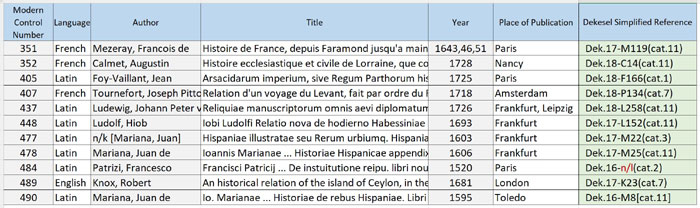
Database entries illustrating Dekesel Referencing.
I have now compiled a database of more than four hundred works using this simplified reference system. In the context of modern Ireland, north and south, it is hoped that this bibliographical survey of numismatic literature within the Edward Worth Library will serve as a point of departure for further research. Dekesel’s monumental project identified holdings in only three Irish repositories: the National Library of Ireland, Trinity College Library, and Marsh’s Library. As noted on the Worth as a Collector webpage, many works present in Worth’s Library are absent from those other Irish collections. This study therefore contributes to the field by collating and locating numismatic publications held in an accessible Irish research library.
Text: David S. Dunlop, Independent Researcher | Bookbinder.
Member of Numismatic Society of Ireland – Northern Branch
Sources
Anon., ‘Peter Burghaus’, Numista [accessed 22 September 2026].
Dekesel, Christian Edmond, ‘The History of Numismatics and Collections’, in Arnold-Biucchi, Carmen, and Maria Caccamo Caltabiano (eds) Survey of Numismatic Research : 2008-2013 (Taormina, Sicily, 2015), pp 734–42.
Boran, Elizabethanne, ‘Alchemy and Chemistry at the Edward Worth Library’, Edward Worth Library online exhibition [assessed 3 August 2026].
Callatay, François de, ‘Curieux et antiquaires (xvie siècle), médecins et jésuites (xviie–xviiie siècles): Les tribulations du ‘connoisseurship’ numismatique’, in Michel, Patrick (ed.), Connoisseurship: L’œil, la raison et l’instrument; Actes du colloque École du Louvre en partenariat avec la Fondation Calouste Gulbenkian et l’Institut national d’histoire de l’art, 20, 21 et 22 octobre 2011 (Paris, 2014), pp 177–200.
Callatay, François de (ed.), Numismatic Antiquarianism through Correspondence (16th–18th c.): In the Margin of the Project Fontes Inediti Numismaticae Antiquae (FINA) (New York, 2023).
Carlile, W. W., ‘The Relation of Economics to Numismatics’, Proceedings of the Royal Philosophical Society of Glasgow, XXXIII (1901–1902), 81–92.
Cooper, Alix, ‘The Museum and the Book: The Metallotheca and the History of an Encyclopaedic Natural History in Early Modern Italy’, Journal of the History of Collections, 7, no. 1 (1995), 1–23.
Dekesel, Christian Edmond, Bibliotheca Nummaria : Bibliography of 16th Century Numismatic Books ; Illustrated and Annotated Catalogue (London and Crestline, Calif., 1997).
Dekesel, Christian Edmond, Bibliotheca Nummaria II : Bibliography of 17th Century Numismatic Books ; Illustrated and Annotated Catalogue, 3 vols (London and Crestline, Calif., 2003).
Dekesel, Christian Edmond, and Yvette M. M. Dekesel-De Ruyck, Bibliotheca Nummaria III : Bibliography of 18th Century Numismatic Books ; Illustrated and Annotated Catalogue, 6 vols (London and Crestline, Calif., 2009–19).
De La Garanderie, Marie-Madeleine, ‘Guillaume Budé, a Philosopher of Culture’, The Sixteenth Century Journal, 19, no. 3 (1988), 379–88.
Dibon, Paul, ‘Naples et L’Europe savante dans la second moitié du XVII siècle’, Nouvelles de la République des Lettres, 1 (1984), 27–45.
Frey, Albert R., and Mark M. Salton, Dictionary of Numismatic Names : with Addenda ; with Glossary of Numismatic Terms in English, French, German, Italian, Swedish (London, 1973).
Haskell, Francis, History and Its Images : Art and the Interpretation of the Past (New Haven, Conn. and London, 1993).
Kennedy, Máire, ‘Book Mad: The Sale of Books by Auction in Eighteenth-Century Dublin’, Dublin Historical Record, 54, no. 1 (2001), 48–71.
Lipsius, J. G., and J. Leitzmann, Bibliotheca Numaria : A Bibliography of Numismatic Books Printed before 1800 ; with the Supplement to 1866 (Colchester, 1977).
Martin, Sean, Alchemy and Alchemists (Harpenden, Hertfordshire, 2006).
Meadows, Andrew, ‘Numismatics’, in Graziosi, Barbara, Phiroze Vasunia and George Boys-Stones (eds), The Oxford Handbook of Hellenic Studies (Oxford University Press, 2009), pp 734–46.
Pearsall, Judy (ed.), The New Oxford Dictionary of English (Oxford, 2001).
Renauldin, L. J., Études Historiques et Critiques sur les Médecins Numismatistes : Contenant leur Biographie et L’Analyse de leurs Écrits (Paris, [1852]).
Sjøvoll, Therese,‘Queen Christina of Sweden’s Musaeum : Collecting and Display in the Palazzo Riario’ (Columbia University, Ph. D., 2015).
Westerhof, Danielle, ‘Introduction: the intellectual alchemy of medicine and print’, in Danielle Westerhof (ed.), The Alchemy of Medicine and Print : the Edward Worth Library, Dublin (Dublin, 2010), pp 13–21.
Whitley, James, ‘Archaeology’, in Graziosi, Barbara, Phiroze Vasunia and George Boys-Stones (eds) The Oxford Handbook of Hellenic Studies (Oxford, 2009), 720–33.
__
[1] Pearsall, Judy (ed.), The New Oxford Dictionary of English (Oxford, 2001), p. 1272.
[2] Frey, Albert R., and Mark M. Salton, Dictionary of Numismatic Names : with Addenda ; with Glossary of Numismatic Terms in English, French, German, Italian, Swedish (London, 1973), Addenda, p. xvii: ‘Numismatics – the science, study or collecting of coins, tokens, medals, paper money, orders, decorations and similar objects’.
[3] Dekesel, Christian Edmond, Bibliotheca Nummaria : Bibliography of 16th Century Numismatic Books ; Illustrated and Annotated Catalogue (London and Crestline, Calif., 1997), p. viii. With thanks to Dr Jonathan Moore for translation assistance.
[4] Worth had other general bibliographical works also, such as Giovanni Battista Caruso’s, Bibliotheca historica regni Siciliae … (Palermo, 1723).
[5] Labbe, Philippe, Bibliotheca bibliothecarum curis secundis auctior, accedit Bibliotheca nummaria in duas partes tributa. I. De antiquis numismatibus. II. De monetis, ponderibus & mensuris. Cum Mantissa antiquariae supellectilis ex annulis, … romanae praesertim antiquitatis monimentis collecta … (Rouen, 1672).
[6] Riechenberg, Adam (ed.), Historiae rei nummariae veteris scriptores aliquot insigniores … (Leiden and Jena, 1695).
[7] Banduri, Anselmo, Bibliotheca nummaria, sive Auctorum qui de re nummaria scripserunt, … atque dissertationibus virorum doctorum de hoc argumento praemissa curante Jo. Alberto Fabricio … (Hamburg, 1719).
[8] Lipsius, J. G., and J. Leitzmann, Bibliotheca Numaria : A Bibliography of Numismatic Books Printed before 1800 ; with the Supplement to 1866 (Colchester, 1977), Publisher’s Preface.
[9] Dekesel, Bibliotheca Nummaria : Bibliography of 16th Century Numismatic Books, p. vii. Dekesel undertakes a critical analysis of three standard numismatic bibliographies, including Lipsius, to demonstrate the need for a radically new and fresh approach to numismatic bibliography: pp xiv–xxxvi.
[10] ‘The scope and time involved in creating such a massive bibliographical instrument will probably, or almost certainly, extend beyond our own mortal lives, but in continuing working within the boundaries of our project we will have established the framework in which other bibliographical researchers will be able to continue or finish this ‘Masterplan’: Dekesel, Christian Edmond, and Yvette M. M. Dekesel-De Ruyck, Bibliotheca Nummaria III : Bibliography of 18th Century Numismatic Books ; Illustrated and Annotated Catalogue, 6 vols (London and Crestline, Calif., 2009–19), i, p. 10.
[11] Dekesel’s ‘Introduction’ in the first volume of each century contains his prolegomena, critical to understanding his method and rationale for inclusion; that of the sixteenth century being the fullest exposition of it (Bibliotheca Nummaria : Bibliography of 16th Century Numismatic Books, pp vii–xli), though that of the eighteenth century gives the best exposition of his categorisations (Bibliotheca Nummaria III : Bibliography of 18th Century Numismatic Books, pp 7–46). Each volume has a multi-faceted index system designed to provide the researcher with many avenues of approach to the entries.
[12] To say nothing of Worth’s 63 volume periodical, Acta Eruditorum, Worth continued to treat even his sales catalogues as important, marking up the numismatic sections and keeping them. Over 50 catalogues remain with at least 14 containing numismatic material. Other catalogues, correspondence and ephemera may have been lost in the house clearance. Kennedy draws attention to the fact that not all sales catalogues were printed but were circulated in manuscript form: Kennedy, Máire, ‘Book Mad: The Sale of Books by Auction in Eighteenth-Century Dublin’, Dublin Historical Record, 54 no. 1 (2001), p. 62.
[13] Dekesel, Bibliotheca Nummaria : Bibliography of 16th Century Numismatic Books, p. vii.
[14] Ibid.
[15] Dekesel, Christian Edmond, Bibliotheca Nummaria II : Bibliography of 17th Century Numismatic Books ; Illustrated and Annotated Catalogue, 3 vols (London and Crestline, Calif., 2003), i, p. vii. Dekesel noted that to have Professor Peter Berghaus (1919–2012), a leading German numismatist, contribute a ‘Foreword’ to his first volume of Bibliotheca Nummaria : Bibliography of 16th Century Numismatic Books, gave him ‘credibility’: ‘to Peter Berghaus who supported me from the first hour, who gave me and the study of the history of numismatics credibility in the numismatic world …’: Dekesel, Bibliotheca Nummaria : Bibliography of 16th Century Numismatic Books, p. xli. An obituary for Berghaus points to his importance in the field of numismatic research: ‘In 1950, Berghaus joined the Westfälisches Landesmuseum für Kunst und Kulturgeschichte in Münster, where he established the Department of Regional History. He became honorary professor of numismatics at the University of Münster in 1961 and served as director of the museum from 1977 until his retirement in 1984. He co-founded the ‘Gesellschaft der deutschen Medaillenfreunde’ in 1967 and held leadership roles in the International Numismatic Commission, serving as vice president from 1973 to 1986’: Anon., ‘Peter Burghaus’, Numista, [accessed 22 September 2026].
[16] Dekesel, Bibliotheca Nummaria II : Bibliography of 17th Century Numismatic Books, ‘Foreword’ by Andrew Burnett, i, p. vii. Dekesel acknowledges the somewhat ‘arbitrary’ nature of attempting categorisation: ‘Every decision as to classification is difficult, and, in some degree misleading … Other categories can also be present in that same publication, but one has to take decisions! We have also arranged the categories in a certain order of numismatic relevance. This again can give cause to endless discussions, but the workability of our classification is based on it’: Dekesel and Dekesel-De Ruyck, Bibliotheca Nummaria III : Bibliography of 18th Century Numismatic Books, i, p. 29.
[17] As Dekesel notes, ‘The ‘categories … represent a diminishing degree of ‘numismaticness’, starting with the pure numismatic studies and digressing to the general historical publications with ephemeral numismatic elements’: Dekesel, Bibliotheca Nummaria : Bibliography of 16th Century Numismatic Books, p. xxxvi. This can perhaps be more clearly seen in his later treatment of the seventeenth and eighteenth centuries where he expands the categories from 6 to 12.
[18] Westerhof, Danielle, ‘Introduction: the intellectual alchemy of medicine and print’, in Danielle Westerhof (ed.), The Alchemy of Medicine and Print : the Edward Worth Library, Dublin (Dublin, 2010), pp 20–1.
[19] Whitley, James, ‘Archaeology’, in Graziosi, Barbara, Phiroze Vasunia, and George Boys-Stones (eds) The Oxford Handbook of Hellenic Studies (Oxford, 2009), p. 721.
[20] As De La Garanderie notes, ‘Budé’s humanism requires totality. Encyclopaedia is a notion particularly dear to him; he spread the use of the word in Latin and introduced it into the French vernacular fifteen years before Rabelais … Nothing is so familiar to him as the images of the circle or sphere of knowledge, or the more poetic symbols, such as Mercury’s caduceus or ‘the Muses, far away on the lonely mountains, dancing round in a ring, with a rope they pass from one to another,’ – which to Bude meant ‘the concord and consanguinity of all disciplines. Disjoined from the whole, each part of knowledge is powerless and fruitless’: De La Garanderie, Marie-Madeleine, ‘Guillaume Budé, a Philosopher of Culture’, The Sixteenth Century Journal, 19, no. 3 (1988), 381.
[21] Martin, Sean, Alchemy and Alchemists (Harpenden, Hertfordshire, 2006), p. 17. Ephraim Chambers’ Cyclopædia, or an universal dictionary of Arts and Sciences … , 2 vols (London, 1728), and Denis Diderot’s Encyclopédie (Paris, 1751) continued in the older philosophical line of knowledge as a unified whole, though the shift towards the modern fragmentation of that unity was already underway. Cooper, consistent with Martin’s evaluation, demonstrates the fracturing of this unity in considering the changing fortunes of Mercati’s Metallotheca in the century between when it was written and when it was published, noting that ‘… the history of a much wider transformation: that of the formation and dissolution of the encyclopaedic natural history as a genre of writing, reading, and scientific activity’: Cooper, Alix, ‘The Museum and the Book: The Metallotheca and the History of an Encyclopaedic Natural History in Early Modern Italy’, Journal of the History of Collections, 7, no. 1 (1995), 1.
[22] Dekesel, Christian Edmond, ‘The History of Numismatics and Collections’, in Arnold-Biucchi, Carmen, and Maria Caccamo Caltabiano (eds) Survey of Numismatic Research : 2008-2013 (Taormina, Sicily, 2015), p. 735.
[23] ‘Alchemy has a two-fold acceptation, respecting the two different things which it pursues: viz. 1. The secret of making gold from any other metal. 2. An universal medicine for the cure of all diseases; which is a distinction of the utmost moment, in an inquiry into the origin of alchemy’, Boerhaave, Herman, A new method of chemistry (London, 1727), p. 10. See Boran, Elizabethanne, ‘Alchemy’, Alchemy and Chemistry at the Edward Worth Library [accessed 3 August 2026].
[24] Ibid.
[25] Martin, Alchemy and Alchemists, p. 15.
[26] Boran, ‘Transmutation of Metals’, Alchemy and Chemistry at the Edward Worth Library [accessed 3 August 2026].
[27] Ibid.
[28] Dekesel, ‘The History of Numismatics and Collections’, p. 735.
[29] 60.5% of entries in Dekesel’s volume on sixteenth-century works falls into Category 11 of the table above.
[30] Haskell, Francis, History and Its Images : Art and the Interpretation of the Past (New Haven, Conn. and London, 1993), Chapter One: The Early Numismatists; Chapter Two: Portraits from the Past [Medals].
[31] Carlile, W. W., ‘The Relation of Economics to Numismatics’, Proceedings of the Royal Philosophical Society of Glasgow, XXXIII (1901–1902), 91.
[32] Haskell, History and Its Images, p. 363.
[33] ‘The heads on the Greek coins up to the time of Alexander are, without exception, the heads of deities, and the symbols on the reverse are, for the most part, symbols connected with their worship’: Carlile, ‘The Relation of Economics to Numismatics’, 85.
[34] Haskell, History and Its Images, p. 14.
[35] Even that which is considered the ‘first numismatic book’, Budé’s De Asse (Paris, 1515), and its shortened form, Breviarium de Asse (c. 1520s), is considered a work on metrology. On this see Meadows, Andrew, ‘Numismatics’, in Graziosi, Barbara, Phiroze Vasunia and George Boys-Stones (eds), The Oxford Handbook of Hellenic Studies (Oxford University Press, 2009), pp 734, 735. Dekesel highlights a series of authors who deal with this ancillary use of numismatics: in his essay ‘The History of Numismatics and Collections’, pp 734–9 respectively.
[36] Dekesel, Bibliotheca Nummaria II : Bibliography of 17th Century Numismatic Works, i, ‘Foreword’ by Andrew Burnett, p. iv.
[37] Haskell, History and Its Images, p. 20, referencing Renauldin’s work which we too reference in light of Worth’s library.
[38] Renauldin, L. J., Études Historiques et Critiques sur les Médecins Numismatistes : Contenant leur Biographie et L’Analyse de leurs Écrits (Paris, [1851]), p. [575].
[39] We have very little correspondence by or to Dr Worth, and perhaps this remains to be the most tantalising discovery for Worth scholars, his putative correspondence in the archives of others. A project has been begun in the last 15 years, to excavate the vast reserves of unprinted numismatic correspondence that formed part of the ‘Republic of Medals’, which Worth may have contributed to. Callatay offers ‘a vivid demonstration [of] how correspondence provides unique inside views on connoisseurship and social networks, and how writing historiography of modern numismatics exclusively through the reduced prism of printed books could be deeply misleading’: Callatay, François de (ed.), Numismatic Antiquarianism through Correspondence (16th–18th c.): In the Margin of the Project Fontes Inediti Numismaticae Antiquae (FINA) (New York, 2023), p. v. Scientific book societies such as the Accademia Etrusca, set up by the Venuti brothers in Italy in 1726 had a large number of foreign members and correspondents. Was Worth connected with such book societies and institutions? He was certainly keeping up to date with new publications and numismatic research through the Acta Eruditorum, a Latin language scientific monthly journal from the Germanic world, which included short essays, book reviews, and notes. Worth had a more-or-less complete set up until 1733 (the year of his death), though he must have purchased back issues as it began in his childhood in 1682. It was a veritable treasure-trove of learning. In 1718, his copy of Michele Mercati’s posthumously published Metallotheca (Rome, 1717) was reviewed (see Worth the Collector, first image). Did he base the purchase on the review? As a periodical, although numismatically relevant, Dekesel did not include Acta Eruditorum in his printed Bibliotheca Nummaria.
[40] Dibon, Paul, ‘Naples et L’Europe savante dans la second moitié du XVII siècle’, Nouvelles de la République des Lettres, 1 (1984), p. 27; Sjøvoll, Therese,‘Queen Christina of Sweden’s Musaeum : Collecting and Display in the Palazzo Riario’ (Columbia University, Ph. D., 2015), pp 54, 58, 59 [accessed 29 August 2026].
[41] Dibon gives us a fascinating insight into the interconnections of Naples and learned Europe in the second half of the seventeenth century. The frequency and importance of the names which appear in his account bears a remarkable affinity with a list of authors in Dr Worth’s library. ‘Vico’s work heralds the real beginning of numismatics as an independent science’, Dekesel, Bibliotheca Nummaria : Bibliography of 16th Century Numismatic Books, ‘Foreword’ by Peter Berghaus, p. iii.
[42] Dekesels originally planned an additional volume which would have included ‘anonymous numismatic publications from the 15thcentury until the very end of the 18th century. It will also include all ordinances, placards [Proclamations?], and coin books’: Dekesel, Bibliotheca Nummaria II : Bibliography of 17th Century Numismatic Books, i, p. vii. Gorini noted further plans in the foreword to the first volume of the Dekesel eighteenth-century multi-volume set: ‘Other phases of their Masterplan will include the numismatic publications during the French Revolution (1789–1799), the auction catalogues between 1599 and 1801 containing numismatic items, numismatic contributions in periodicals, and last but not least the anonymous numismatic publications between 1499 and 1801’, Dekesel and Dekesel-De Ruyck, Bibliotheca Nummaria III : Bibliography of 18th Century Numismatic Books, i, ‘Foreword’ by Giovanni Gorini, p. 6. However, though the Dekesels continue their work, especially on French Revolution material (late eighteenth century), including noting sales catalogues, they have informed me, that they ‘are not planning the publication of our work but are sharing it …’ and have graciously told me that I should ‘feel free to use anything you need’: [personal correspondence between Dekesels and author, 20 December 2025].
[43] See, for example, Eimer numbers (British Commemorative Medals): format: Eimer 1234 – bibliographer encoded. Auction houses, museum catalogues, and scholarly literature routinely cite ‘Eimer’ numbers. Schulman numbers (Dutch coins, 1795–1975): format: Sch. 553 – bibliographer encoded. Auction catalogues and the Dutch Muntalmanak adopt Sch. as the standard reference.
[44] What was treated in sixteenth-century volume as Category 5 and Category 6, was treated in the seventeenth- and eighteenth-century volumes as Category 11. The 6 eighteenth-century volumes drop all Category 12 material due to the burgeoning size of the work.
[45] When consulting my database, the only material change relates to Categories 5 and 6 in the sixteenth century. These are combined and placed into Category 11 in the later two centuries. The square brackets signify a modification not to be found in the work referenced.
[46] Conformable to Dekesel’s reassignment in his later seventeenth- and eighteenth-century works.